
Medicare Enrollment Windows for Agents: IEP, AEP, OEP, SEP
Why Medicare Enrollment Windows Matter for Your Pipeline
Medicare enrollment windows control when your prospects can legally enroll, switch, or change their coverage.
As an agent, these windows don't just affect your clients. They shape your lead strategy, your ad targeting, your messaging, and your income calendar.
An agent who understands all four Medicare enrollment windows for agents builds a pipeline that runs every month. An agent who only knows AEP starts over from scratch every October.
IEP: The Year-Round Medicare Enrollment Window Most Agents Ignore
The Initial Enrollment Period (IEP) is a 7-month window around a person's 65th birthday.
It opens 3 months before the month they turn 65, includes their birthday month, and continues for 3 months after. During IEP, a person can enroll in Medicare Part A and Part B for the first time. They can also choose a Medicare Advantage plan, a Medicare Supplement plan, or a Part D drug plan.
Here is the number that matters for your pipeline: 10,000 people turn 65 every day in the United States.
That means IEP prospects exist in every market, every week of the year — not just in October.
How the IEP Enrollment Window Shapes T65 Targeting
Agents who run T65 campaigns target people who are 3–4 months from their 65th birthday. This gives the lead time to research options, compare plans, and build trust with an agent before their enrollment deadline arrives.
Meta ads let you target by age bracket, so you can reach turning-65 prospects before their inbox fills with competitor mail and calls. At a ~$35 CPL, T65 campaigns are one of the most cost-effective lead sources available to Medicare agents. The prospect is motivated, the window is real, and the need is time-sensitive.
For a detailed breakdown of T65 Facebook targeting, see our guide here: T65 Facebook Targeting: How to Reach People Turning 65.
IEP vs. AEP: Why T65 Leads Are Different
AEP prospects have usually been on Medicare for years. They are comparing plans they already have.
IEP prospects are brand new to Medicare. They need guidance on what to enroll in, how it works, and why their choice matters. That is a different conversation — and it often produces stronger, longer-term client relationships with more cross-sell potential down the road.
AEP: The Medicare Agent's High-Season Window (October 15 – December 7)
The Annual Enrollment Period runs October 15 through December 7. Coverage changes take effect January 1 of the following year.
During AEP, current Medicare beneficiaries can switch from Original Medicare to Medicare Advantage, switch MA plans, change Part D drug plans, or return to Original Medicare. It is open to all Medicare enrollees, not just new entrants.
For most agents, AEP is the highest-volume season. Lead costs rise, competition increases, and the pipeline either delivers or it does not.
How AEP Fits Into a Year-Round Strategy
The agents who perform best during AEP are the ones who built their systems before October — not the ones scrambling to buy leads when the window opens.
AEP should be the harvest, not the seed. Agents who run T65 campaigns from April through September enter AEP with warm relationships and a working system. AEP becomes an amplification of what is already running — not a frantic restart.
If your entire revenue plan is built around these 54 days, one rough AEP can set back your entire year. A year-round Medicare pipeline reduces that risk.
OEP: The Overlooked Medicare Enrollment Window After AEP
The Medicare Advantage Open Enrollment Period (OEP) runs January 1 through March 31.
OEP is for existing Medicare Advantage enrollees only. During this period, they can switch to a different MA plan or drop their plan and return to Original Medicare with a Part D drug plan. Each enrollee can use OEP only once per year.
The Agent Opportunity During OEP
Most agents assume all the action ended on December 7. It did not.
OEP creates a real pipeline of prospects who enrolled in a new plan during AEP and are now reconsidering. Plan fit problems, unexpected costs, network access issues, or a poor enrollment experience are all common reasons a client wants to make a change in January or February.
An agent who stayed in contact after AEP is positioned to help — and earn a new enrollment. OEP is not AEP volume. But it is a meaningful Medicare enrollment window that most agents let pass without a plan.
SEP: When Medicare Leads Are the Highest-Intent
The Special Enrollment Period (SEP) is triggered by qualifying life events outside the standard enrollment windows.
Common SEP triggers include:
- Losing employer-sponsored health coverage
- Moving to a new plan service area
- Qualifying for Medicaid or a low-income subsidy program
- Involuntary loss of creditable prescription drug coverage
SEP prospects are acting because something changed in their situation. The urgency is immediate, the timeline is short, and they need answers fast. That makes them some of the most conversion-ready leads in Medicare sales.
How Agents Capture SEP Leads
SEP leads are difficult to target proactively with ads because the triggering event is unpredictable. They are better captured through referral networks, employer HR contacts, and inbound organic content.
A blog or website that explains SEP triggers in plain language attracts agents and their clients who are searching for answers right after a qualifying event. This is one reason content-based lead gen pays off in Medicare — SEP searchers are high-intent and often ready to act on the same day.
Building a Year-Round Medicare Pipeline Around These Windows
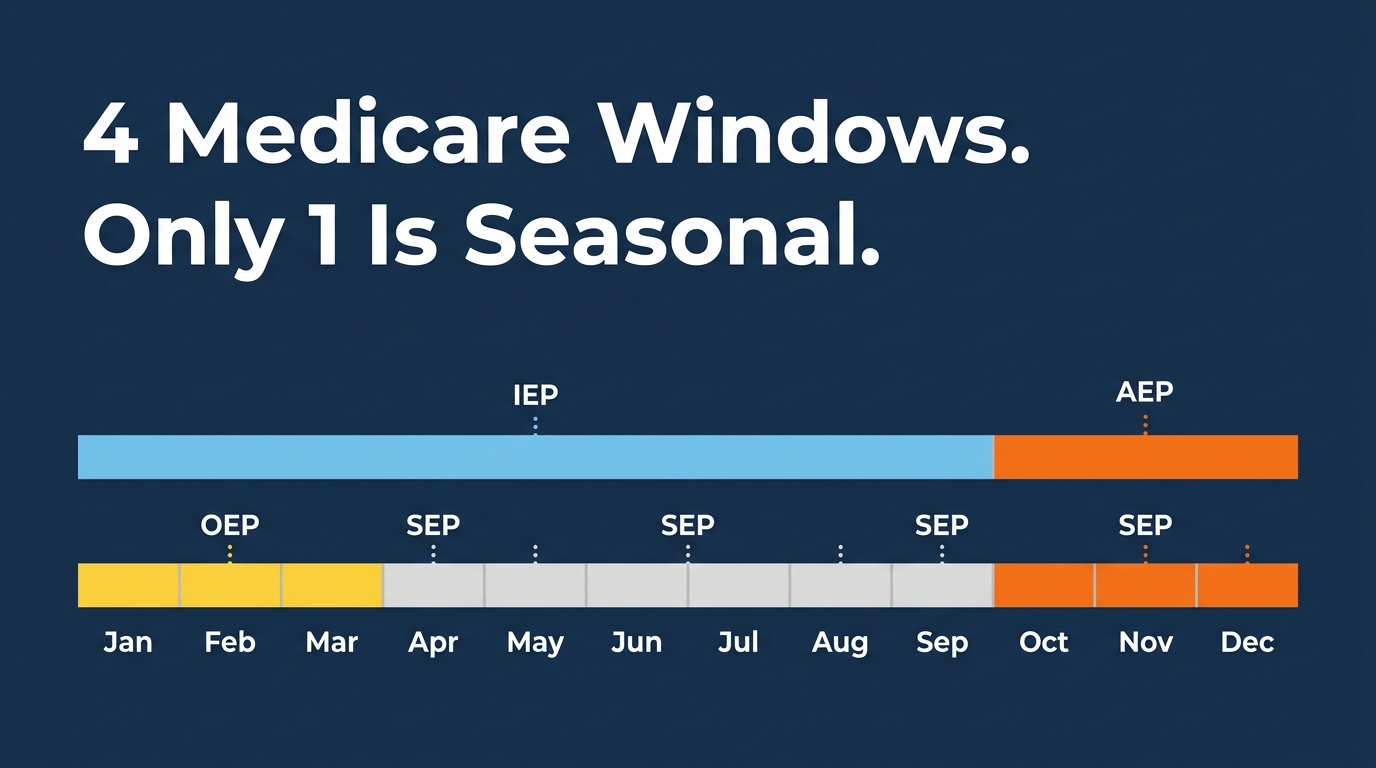
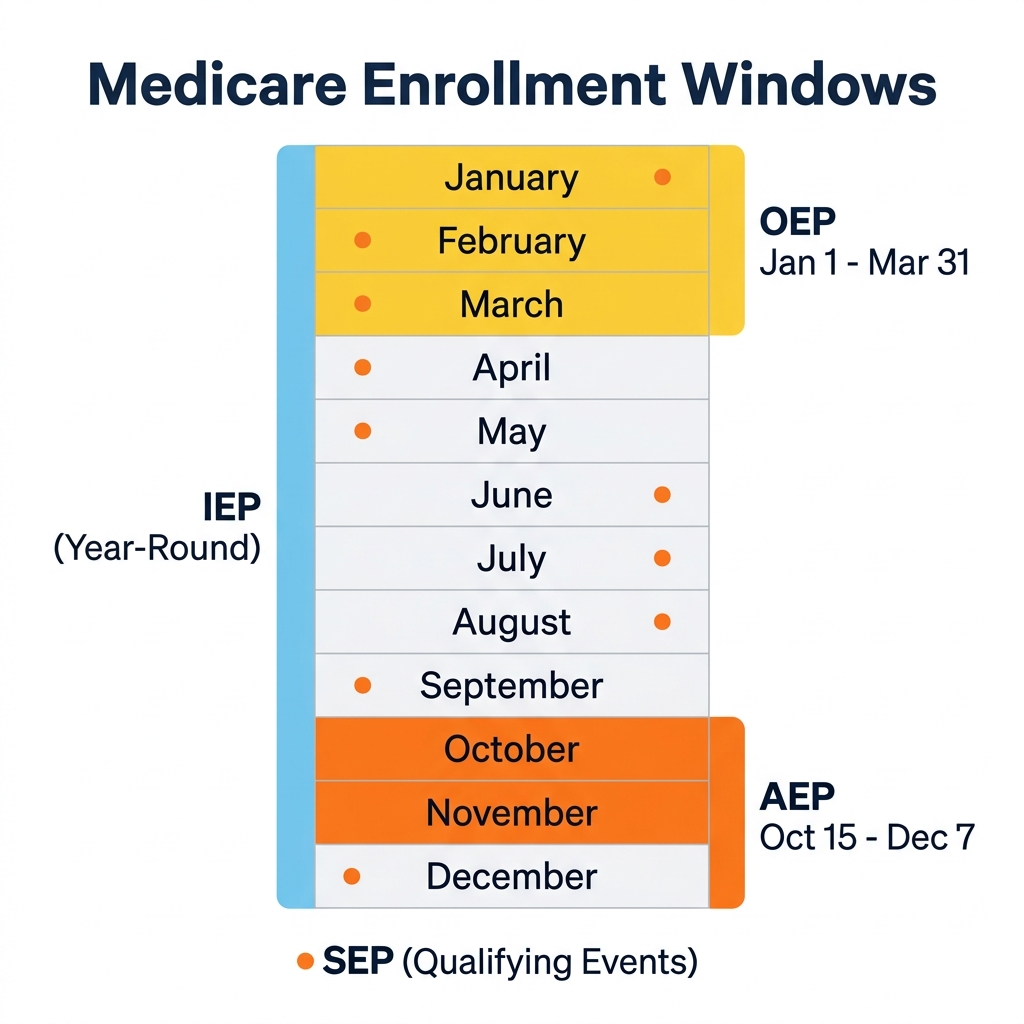
Here is what the calendar looks like when you map out all four Medicare enrollment windows for agents:
- IEP — Year-round (continuous): 10,000 people turn 65 every day. Run T65 campaigns month after month. This is the foundation of a pipeline that does not depend on AEP.
- Pre-AEP — July through September: Build lists, warm up past clients, and refine your follow-up system before the high-season window opens.
- AEP — October 15 through December 7 (54 days): Run at full capacity. This window is fixed and finite — do not waste it trying to set up systems.
- OEP — January 1 through March 31: Stay in contact with recent AEP enrollees. Follow up with clients who had doubts in December. Capture plan switches before March 31.
- SEP — Year-round: Build referral pipelines and organic content to capture high-intent prospects when qualifying events occur.
AEP is 54 days per year. That leaves 311 days where IEP, OEP, and SEP opportunities exist — and most agents are nowhere.
Understanding all four Medicare enrollment windows is the difference between running a seasonal business and running an actual pipeline. For more on building the year-round version, see: How to Build a Year-Round Medicare Pipeline.
Are you taking advantage of every Medicare enrollment window — or just AEP?
Take the free 60-second assessment and get your personalized Medicare Lead Gen Roadmap. It shows you exactly which part of your pipeline is leaking — and what to fix first — free, no pitch.
[Get Your Free Medicare Lead Gen Roadmap → https://sixtyfive-leads.lovable.app/roadmap]
Frequently Asked Questions
Q: What are the Medicare enrollment windows for agents to focus on? A: The four Medicare enrollment windows agents should know are the IEP (7-month window around a prospect's 65th birthday), AEP (October 15 – December 7), OEP (January 1 – March 31, for current MA enrollees only), and SEP (triggered by qualifying life events year-round). Agents who work all four build a year-round pipeline instead of depending on AEP alone.
Q: What is the IEP in Medicare and how long does it last? A: The Initial Enrollment Period is a 7-month window around a person's 65th birthday. It begins 3 months before their birthday month, includes the birthday month itself, and runs 3 months after. During IEP, a person can enroll in Medicare Part A, Part B, and select a Medicare Advantage or Supplement plan for the first time.
Q: What is the difference between AEP and OEP for Medicare agents? A: AEP (Annual Enrollment Period, October 15 – December 7) is when all Medicare beneficiaries can change their coverage for the following year. OEP (Medicare Advantage Open Enrollment Period, January 1 – March 31) is more limited — only current MA enrollees can use it, only once per year, to switch MA plans or return to Original Medicare.
Q: What triggers a Medicare Special Enrollment Period? A: Common SEP triggers include losing employer-sponsored health coverage, moving to a new service area, qualifying for Medicaid or a low-income subsidy, and involuntary loss of creditable drug coverage. These events allow beneficiaries to enroll or change plans outside the standard AEP and OEP windows — and create high-intent leads for agents year-round.