
Medicare Facebook Ads Compliance for Insurance Agents
Why Medicare Facebook Ads Compliance Is Harder Than Other Industries
Medicare advertising sits at the intersection of Meta's Special Ads Category rules and federal CMS requirements for TPMOs (Third Party Marketing Organizations). Most industries only have to satisfy one set of rules. Medicare agents have to satisfy both, at the same time.
Meta will auto-disapprove ads that violate its platform policy before a human even reviews them. CMS compliance violations are a separate problem that can trigger corrective action at the carrier level. Passing Meta does not mean you are CMS-compliant. And being CMS-compliant does not guarantee Meta approves the ad.
The Two Compliance Layers Every Medicare Agent Must Know
Layer 1 — Meta Platform Policy: Governs what your ad creative says, how you target, and what claims you make. Insurance falls under the Special Ads Category, which removes several targeting options and adds restrictions on copy language.
Layer 2 — CMS/TPMO Rules: Governs what a TPMO can say about Medicare plans in any marketing material. This applies regardless of where the ad runs.
Meta's Special Ads Category: What Changed for Medicare Agents
When you advertise Medicare products on Meta, your campaign must be designated as a Special Ads Category for insurance. This removes targeting tools that most advertisers rely on.
What You Can No Longer Target on Meta
- Specific age ranges
- Gender
- ZIP codes (minimum 15-mile radius only)
- Lookalike Audiences built from customer lists
As of 2026, Meta runs ongoing policy audits on active campaigns. An ad approved in January can be flagged in March if enforcement thresholds update. Medicare Facebook ads compliance is not a one-time check.
What Targeting Still Works for Medicare Facebook Ads
Interest-based targeting remains available: Medicare, Medicare Advantage, retirement planning, Social Security, health insurance, AARP. Custom Audiences from your own email list are permitted. Retargeting warm traffic from your landing page is still one of the most effective tactics available.
What You Cannot Say in Medicare Facebook Ad Copy
Medicare Facebook Ad Copy That Gets Disapproved
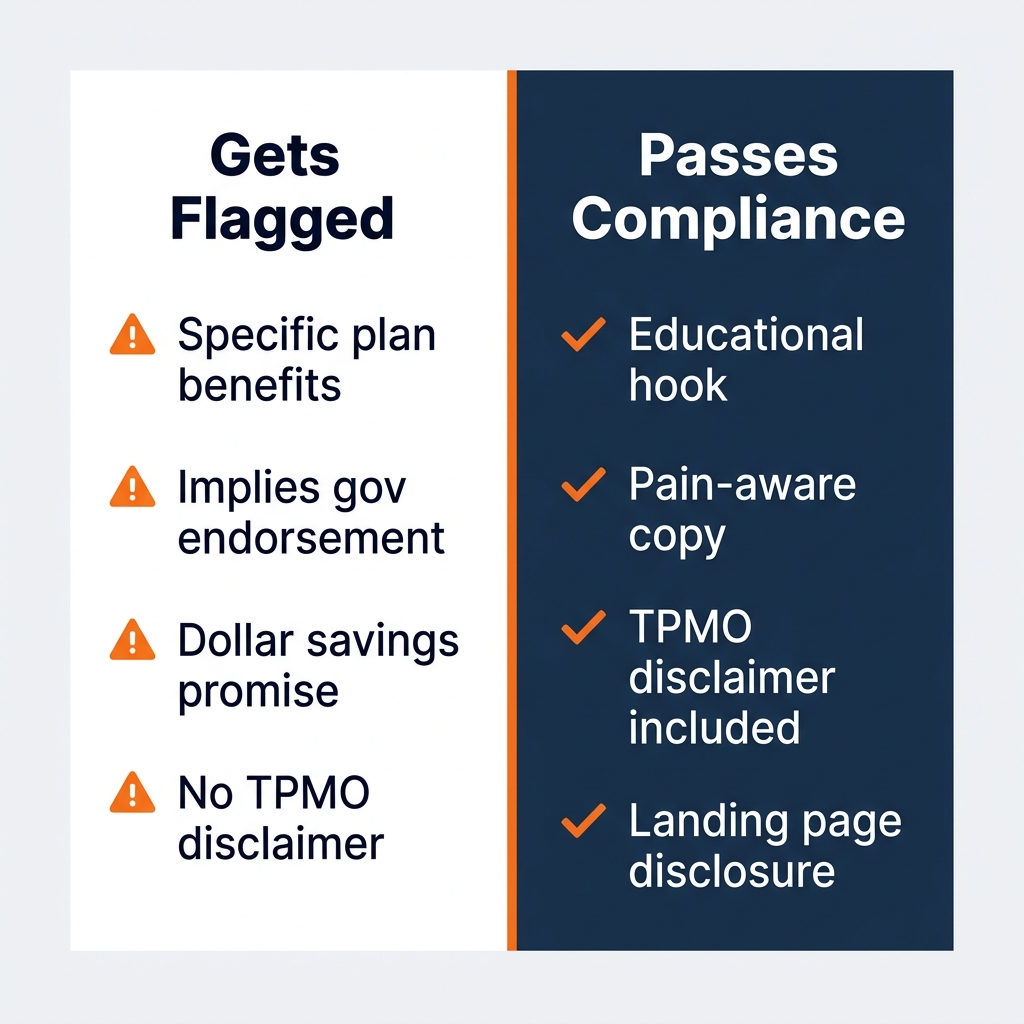
Specific plan benefits without carrier approval. Promising $0 premiums, specific dollar amounts, or coverage features without CMS pre-approval and carrier authorization will get your ad flagged or disapproved.
Implied government endorsement. Using "Medicare," "CMS," or "Department of Health and Human Services" in ways that imply your agency is endorsed by or affiliated with the government is a CMS violation.
Claims you offer all available plans. If you represent a limited number of carriers, your ad cannot imply you offer every plan in the area.
What You CAN Say in a Compliant Medicare Facebook Ad
Educational Hooks
- "AEP starts October 15. Do you know what changed for your coverage this year?"
- "Turning 65 soon? Here is what most people get wrong about their Medicare choices."
- "Are you paying more for your Medicare coverage than you need to be?"
Pain-Aware Hooks
- "Comparing Medicare plans alone is overwhelming. A licensed agent can help at no cost to you."
- "Most people do not know they can review their Medicare plan every year during AEP."
Both hook types get the prospect to click through to your landing page where full information and disclosures appear. The ad starts the conversation. The landing page and the call close it.
The TPMO Disclaimer: Required on Every Medicare Marketing Material
If your Facebook ad has intent to market Medicare coverage, the TPMO disclaimer must be included. The required text:
"We do not offer every plan available in your area. Currently we represent [X] organizations which offer [Y] products in your area. Please contact Medicare.gov, 1-800-MEDICARE, or your local State Health Insurance Program (SHIP) to get information on all of your options."
On social media, this typically appears in the ad body text or as a visible footnote. The practical approach: drive traffic to a landing page where the full disclaimer is prominently displayed.
How to Make Medicare Facebook Ads Compliance Work for You
The framework that consistently works:
- Use an educational or pain-aware hook — no specific benefit claims
- Include the TPMO disclaimer in the ad body or on the landing page
- Drive traffic to a landing page with full disclosures and a clear CTA
- Use GHL automation to follow up with every lead within 5 minutes
- Target by interest rather than age
- Designate the campaign under the Special Ads Category
Our 90-Day Medicare Appointment Sprint is built around this exact framework. We write compliant ad copy, build your landing page, manage your Meta campaign, and track cost per booked appointment. We guarantee 25 qualified appointments in 90 days. [Learn more about the Sprint here.]
Medicare Facebook Ads Compliance Requires Both Layers
Getting one layer right is not enough. An ad that passes Meta review but violates CMS rules is still a compliance problem. An ad that satisfies CMS guidelines but triggers Meta's disapproval never reaches a single prospect.
Medicare Facebook ads compliance means treating both sets of rules as non-negotiable from the moment you write the first line of copy.
Wondering how your current lead gen setup compares to what is actually working right now?
Take the free 60-second assessment and get your personalized Medicare Lead Gen Roadmap. It shows exactly where your pipeline is leaking and what to fix first. Free, no pitch.
[Get Your Free Medicare Lead Gen Roadmap -> https://sixtyfive-leads.lovable.app/roadmap]
Or if you want to see what a compliant, managed Meta campaign looks like for your market, book a free 20-minute strategy call. No pitch. Just a look at your numbers. [Book here -> https://api.leadconnectorhq.com/widget/bookings/dylan-conner-personal-calendar-60hhrscqv]
Frequently Asked Questions
Q: Why do Medicare Facebook ads keep getting disapproved? A: The most common causes are specific plan benefit claims, missing TPMO disclaimers, and copy that implies government endorsement. Meta's automated review flags these in the Special Ads Category before a human reviews the ad.
Q: Can Medicare agents still run Facebook ads in 2026? A: Yes. Medicare Facebook ads compliance requires working within the Special Ads Category restrictions and following CMS TPMO rules. Agents who use educational hooks, include the required disclaimer, and drive traffic to compliant landing pages run effective campaigns.
Q: What is the TPMO disclaimer and is it required on Facebook ads? A: The TPMO disclaimer is a required CMS disclosure stating you do not offer every plan in the area and directing prospects to Medicare.gov or 1-800-MEDICARE. If your Facebook ad has intent to market Medicare coverage, the disclaimer must appear in or alongside the ad.
Q: What Medicare ad copy is safe to use on Meta? A: Educational hooks and pain-aware copy that reference AEP timing, common Medicare misconceptions, or the agent's role as a no-cost resource are the safest approach. Copy that promises specific plan benefits, dollar savings, or implies government affiliation will typically be disapproved.