Shared Medicare Leads: Why Your Calls Go Unanswered
You bought the leads. You called them. Nobody picked up.
This isn't a you problem. It's a math problem — and the math on shared leads is broken before you ever dial.
What Shared Medicare Leads Actually Are
A shared lead is a contact record sold to multiple agents at the same time.
A prospect fills out a form on a lead vendor's website. That form submission gets sold to 5, 8, sometimes 10 different agents — all in the same market. You're one of them.
By the time you call, so have several others. Some called within minutes. The prospect has already talked to two agents, ignored three more calls, and labeled your number as spam.
That's not a contact problem. That's what shared lead math looks like in practice.
The Contact Rate Data Is Stark
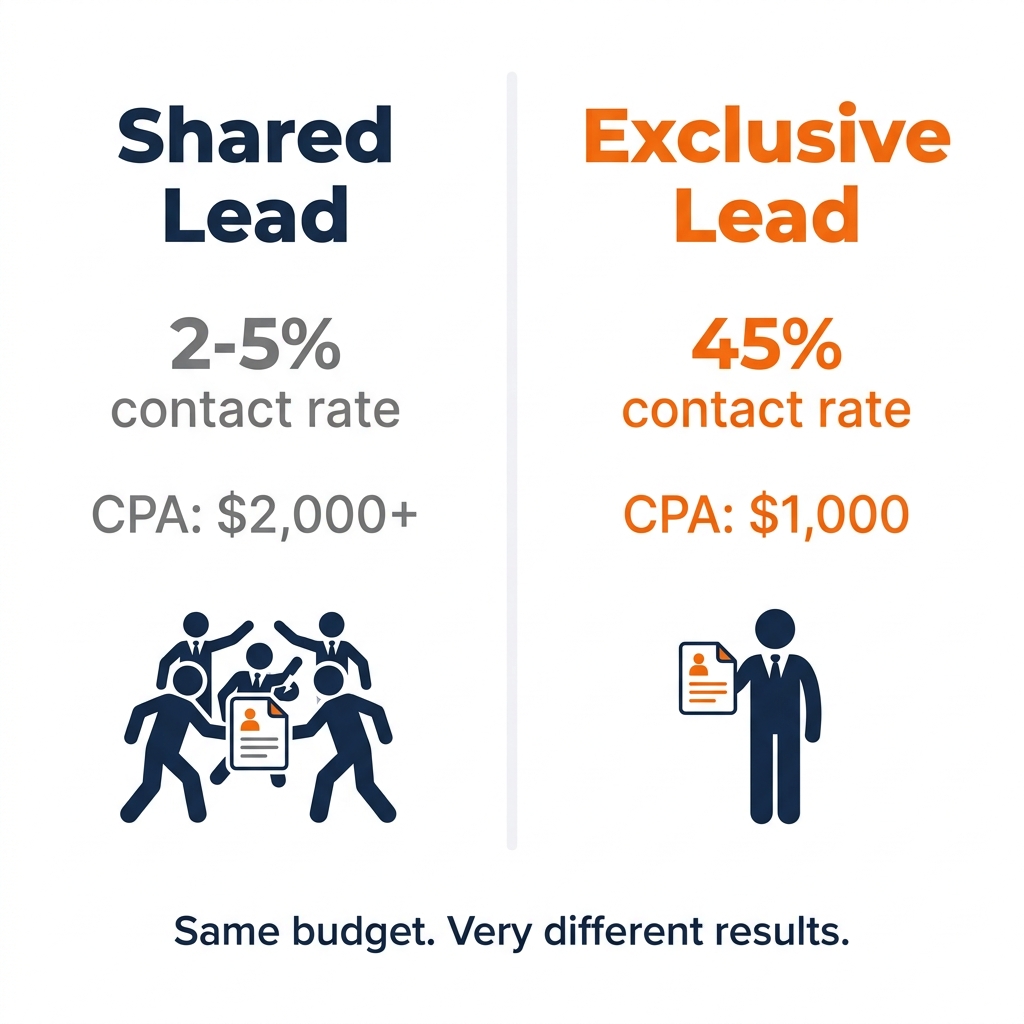
Here's what the numbers show for shared leads vs. exclusive leads:
- Shared lead contact rate: 2–5%
- Exclusive lead contact rate: up to 45%
- Shared lead cost per acquisition: $2,000+
- Exclusive lead cost per acquisition: ~$1,000
A shared lead at $40 sounds cheaper than an exclusive lead at $100. But when you close 2% vs. 45%, the "cheap" lead costs you twice as much per client.
You're not saving money. You're buying a harder race.
Speed to Lead Won't Save a Shared Lead
The standard advice is: call faster. Get there first.
That's true — but it only goes so far.
Research shows that contacting a lead within 5 minutes can dramatically improve conversion. But "within 5 minutes" assumes you're the first call. With shared leads, the vendor is selling to multiple buyers simultaneously. Someone else may already have beat you.
And even when you do get there first, the prospect signed up for "Medicare information" — not a call from an agent. They're not expecting you. They're not primed to buy.
Speed helps. It doesn't fix the fundamental problem.
Why the Problem Is Getting Worse
CMS now requires one-to-one consent before an agent can contact a Medicare prospect.
That sounds like it would help. And it does — a little. But most lead aggregators are still working around this by getting vague blanket consent at the form level.
Meanwhile, the leads you're buying have often been sitting in a queue. They're aged by the time they hit your inbox. The prospect filled out a form 48 hours ago. They've moved on.
The shelf life of a Medicare lead is short. Shared leads have an even shorter one.
What Agents Who Stopped Buying Shared Leads Are Doing Instead
The agents breaking out of this cycle aren't finding better lead vendors. They're building their own lead flow.
Here's what that looks like:
1. Own the opt-in Run your own Meta ads. The prospect fills out your form, opts in to hear from you specifically, and gets a text from you within minutes. No competition. No stale data.
2. Automate the first contact A GHL (GoHighLevel) automation fires the second someone opts in. SMS + email hit immediately. By the time you manually dial, they've already heard from you twice.
3. Target T65 prospects specifically People turning 65 for the first time have never been on a shared lead list. They haven't been called by 10 agents. They're making their first Medicare decision and they need a guide — not a race.
4. Book appointments, not just leads A raw lead is not a booked appointment. Agents with consistent income have a setter or an automated booking flow that converts leads into calendar slots. The lead is only the beginning.
The Real Cost Comparison
Here's an honest look at what shared leads actually cost when you run the full math:
| Shared Leads | Owned Lead System | |
|---|---|---|
| Cost per lead | $30–$50 | $30–$40 (your own ad spend) |
| Contact rate | 2–5% | 30–60% (exclusive opt-in) |
| Leads to get 1 appointment | 40–50 leads | 5–8 leads |
| True cost per appointment | $1,200–$2,500 | $150–$320 |
| Competition on each lead | 5–10 agents | None |
The math doesn't need spin. It just needs to be seen clearly.
Ready to Stop Buying Leads You Can't Reach?
If you've been frustrated with low contact rates, it's not your follow-up. It's the lead type.
The fix isn't a better vendor. It's a different system entirely.
Want to see what a real Medicare appointment pipeline looks like — without shared leads?
Book a free 20-minute strategy call. We'll look at your current lead flow, show you what exclusive T65 campaigns look like for your market, and give you a realistic picture of what consistent booked appointments could look like — no pitch, no obligation.
[Book Your Free Strategy Call →]
Frequently Asked Questions
Q: Why do shared Medicare leads have low contact rates? A: Shared leads are sold to multiple agents simultaneously — often 5 to 10 buyers for the same prospect. By the time you call, the prospect has already received calls from other agents, ignored several numbers, and may have labeled your number as spam. Contact rates for shared leads typically run 2–5%, compared to 30–45% for exclusive, self-generated leads.
Q: What is a good contact rate for Medicare leads? A: For self-generated or exclusive leads with immediate follow-up automation, a 30–45% contact rate is achievable. For shared or aged leads, 2–10% is typical. If your contact rate is below 15%, the issue is almost always the lead source — not your follow-up process.
Q: Are exclusive Medicare leads worth the higher cost? A: Yes — when you factor in the full cost per appointment, not just cost per lead. A $40 shared lead with a 2% conversion rate costs $2,000 per acquisition. A $100 exclusive lead with a 10% conversion rate costs $1,000. Exclusive leads cost less per client closed, even though they cost more per lead purchased.
Q: How fast should you call a Medicare lead? A: Within 5 minutes for shared leads — but even that often isn't fast enough. For your own opt-in leads, automated SMS and email should fire within 60 seconds. Speed matters most when you're competing with other agents. When you own the lead, speed still helps — but you're not racing anyone.