How to Build a Year-Round Medicare Pipeline | SixtyFiveLeads
Most Medicare agents make the same mistake. They grind through AEP, close hard from October through December, then watch their pipeline go quiet.
By February, they're starting over.
That cycle isn't bad luck. It's a system problem. And it's fixable.
Why AEP Creates the Feast-Famine Trap
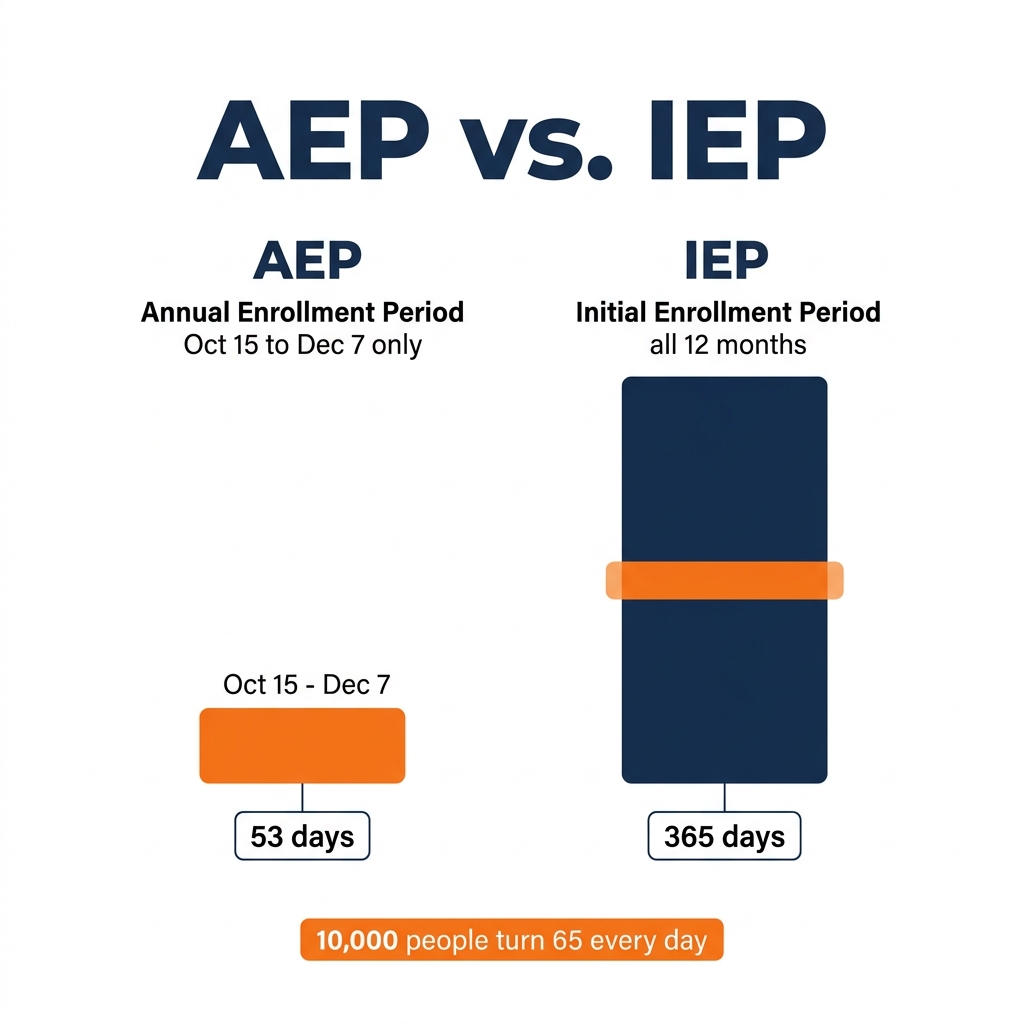
AEP runs October 15 through December 7. Every agent in the country is running ads, buying leads, and calling the same list.
Competition is at its peak. Lead costs spike. Prospects are overwhelmed.
And then it ends. January hits and most agents have nothing queued up.
The agents who break this cycle don't work harder during AEP. They build systems that run all year.
The Real Opportunity Most Agents Miss: IEP
Here's a number worth knowing. Every single day, 10,000 people in the U.S. turn 65.
That's not an AEP number. That's every day, 365 days a year.
When someone turns 65, they enter their Initial Enrollment Period (IEP). It opens three months before their birthday month and stays open for three months after. That's a six-month window — for one person.
Multiply that by the number of people turning 65 in your market. That's your year-round pipeline.
IEP prospects aren't shopping during a national enrollment window. They're shopping because their birthday is coming. The competition is lower. The intent is high. And they need guidance fast.
This is where year-round pipelines are built.
What a Year-Round Pipeline Actually Looks Like
It's not complicated. It has four parts.
1. A consistent traffic source
You need leads coming in every week — not just in October. Meta ads targeted to ages 60–72 with Medicare-related interests run year-round. Budget doesn't have to be large. $30–$50 per day, per ad set, is enough to keep leads flowing.
The key is targeting IEP-eligible prospects specifically. Facebook lets you target by age range. Focus on 63–66. These are people entering or inside their IEP window.
2. A fast follow-up system
Speed matters more than almost anything in Medicare lead gen. A lead that doesn't hear from you in five minutes has likely already moved on to the next agent.
You need an automated system that fires a text and email the moment a lead opts in. GoHighLevel (GHL) handles this well. The first message goes out in under two minutes. A setter call happens within the hour.
Most agents are calling leads the next morning. That's too late.
3. A setter who books appointments
Closing is your job. Booking is someone else's job.
A setter's only role is to call, text, and confirm appointments. They follow a two-touch framework — one call 24 hours before the appointment, one text one to two hours before.
This alone moved one of our clients from a 48% show rate to 79% in 30 days.
4. A CRM that tracks everything
If you can't see your pipeline, you can't manage it. GHL gives you a full view: new leads, contacted, appointment set, confirmed, showed, closed, no-showed.
When you can see every stage, you can fix problems before they cost you appointments. A drop in show rate is visible early. A spike in CPL shows up before you waste budget.
The Math Behind a Consistent Monthly Pipeline
Let's run the numbers at a modest pace.
Say you're generating 30 leads per week at a $35 CPL. That's about $1,050 per week in ad spend.
At a 22% book rate, that's about 6–7 appointments booked per week.
At a 75% show rate, roughly 5 of those show up.
If you close 30% of the ones who show, that's 1–2 closed clients per week. Every week.
One closed Medicare Advantage client is worth roughly $611 in year-one commissions. With renewals, the five-year LTV on that client is $1,500–$2,000.
Over 12 months, a consistent pipeline like this doesn't spike in October. It compounds.
What's Different About Agents Who Never Start Over
They didn't find a magic lead source. They built a system.
Their ads run in January. Their setter calls leads on a Tuesday in March. Their GHL pipeline has prospects in every stage on a Wednesday in July.
AEP is a good month for them — but not the only good month.
The shift isn't complicated. It's committing to consistency over sprints.
How to Get Started
If you're coming out of an AEP cycle with a quiet pipeline, here's the order of operations.
- Set up a Meta campaign targeting age 63–66 with Medicare interests. Start at $30/day.
- Connect that campaign to a GHL account with an instant lead notification and automated first message.
- Book a setter — even part-time — to handle outreach and confirmations.
- Run it for 30 days. Don't optimize until you have data.
The first 30 days are slow. Days 31–90 are where the system starts paying for itself.
Want to see what a real Medicare appointment pipeline looks like — month by month, not just during AEP?
Book a free 20-minute strategy call. We'll walk through your current lead flow, show you what we'd build, and give you a realistic picture of what consistent appointments look like for your market.
No pitch. No obligation.
[Book Your Free Strategy Call →]
Frequently Asked Questions
Q: Can I run Medicare ads year-round, or is it only for AEP? A: You can run ads year-round. IEP targeting — reaching people turning 65 — works every day of the year. AEP is one window. IEP is 365 days.
Q: How much should I spend on ads outside of AEP? A: $30–$50 per day per ad set is enough to generate consistent leads in most markets. You don't need to scale hard in the off-season — just keep leads flowing steadily.
Q: What's the difference between a lead and a qualified appointment? A: A lead is an opt-in. A qualified appointment is a Medicare-eligible prospect who confirmed a call, showed up, and spoke with you for at least 10 minutes. The system between those two points — follow-up, setter, confirmation — is what most agents are missing.
Q: Do I need GoHighLevel to build a year-round pipeline? A: You need some form of CRM with automation. GHL is the platform we use because it handles lead routing, SMS, email, calendar booking, and pipeline tracking in one place. It's not the only option, but it's the best fit for Medicare appointment systems at this scale.
*Published: April 3, 2026 | Author: Dylan Conner | SixtyFiveLeads*