
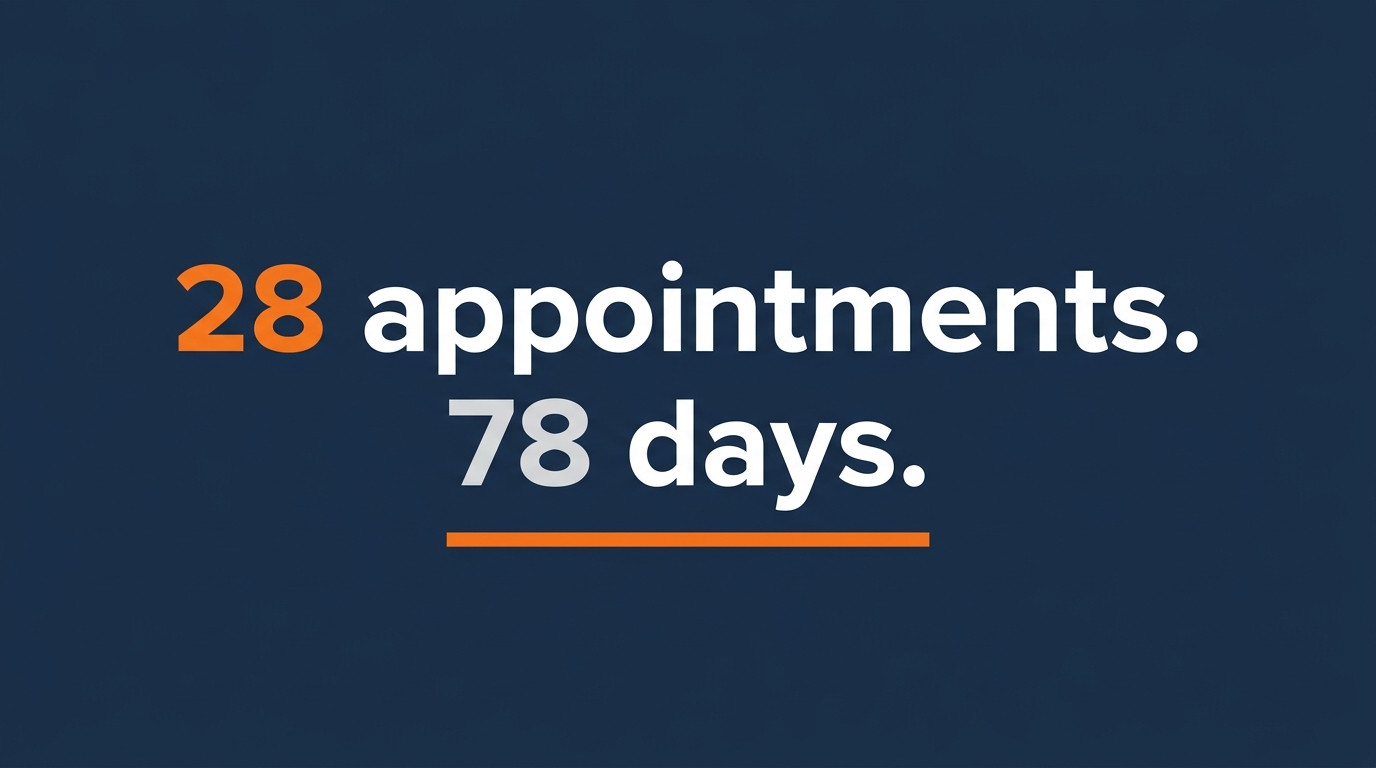
28 Medicare Appointments in 78 Days: Campaign Breakdown
Why We're Sharing the Data
Most lead gen companies show you the outcome.
They don't show you what week 2 looks like. Or week 6. Or the point where the data shifts and you can see it working.
This post does. Because that's what skeptical Medicare agents actually need to make a decision.
The agent in this case study sells Medicare Advantage. He's been in the industry for four years. Before working with us, he was buying shared leads from two vendors and booking maybe 5–7 appointments a month — when things were good.
He wanted consistency. Not more leads. More appointments.
Week 1–2: Setup Before Spend
No leads came in during the first two weeks.
That's by design. We don't run ads until the system is ready.
Week 1 and 2 were spent on:
- Meta ad account setup and pixel install
- Offer creation and hook testing (we wrote 6 hooks, planned to test 3 head-to-head)
- Landing page build with GHL integration
- Lead routing, SMS sequence, and setter calendar configured
- Full pipeline built in GHL with 8 stages
By the end of week 2, ads were live. The budget started at $40/day.
Week 3–4: First Data, First Appointments
Leads started coming in at $47 CPL in week 3.
That's higher than target. It always is at the start. Meta's algorithm is learning what a converting user looks like.
By week 4, CPL had dropped to $38 as the algorithm found its footing.
Results through week 4:
- Leads generated: 22
- Appointments booked: 4 (18% book rate — below target)
- Appointments showed: 3 (75% show rate — on target)
- Enrolled: 1
The book rate was a flag. We audited the setter's contact timing and found they were calling 4+ hours after lead opt-in. We moved to a 5-minute contact protocol and assigned a faster SMS trigger.
Week 5–6: Optimization Kicks In
This is where most campaigns either click or don't.
CPL dropped to $34. One of the three hooks was outperforming the other two by 40% — we paused the underperformers and put 80% of the budget behind the winner.
Results through week 6:
- Total leads: 58
- Appointments booked: 12 (21% book rate — near target)
- Appointments showed: 9 (75% show rate)
- Enrolled: 3
The agent's comment after week 6: "I've never had 12 appointments booked at once. I don't know what to do with this."
We told him to keep his follow-up notes tight and trust the pipeline.
Week 7–9: Full Stride
The campaign hit a rhythm.
CPL stabilized at $34. Book rate climbed to 23% — above our 22% benchmark. The setter was hitting sub-5-minute contact times on over 80% of incoming leads.
We increased budget to $55/day in week 8 to capitalize on the momentum.
Results through week 9:
- Total leads: 98
- Appointments booked: 22 (22% book rate — on target)
- Appointments showed: 17 (77% show rate — above target)
- Enrolled: 5
At this point, we were on pace to hit 25 appointments by day 85. Ahead of schedule.
Week 10–11: 28 Appointments by Day 78
We hit the guarantee number — 25 appointments — on day 71.
The campaign kept running. By day 78, the total reached 28.
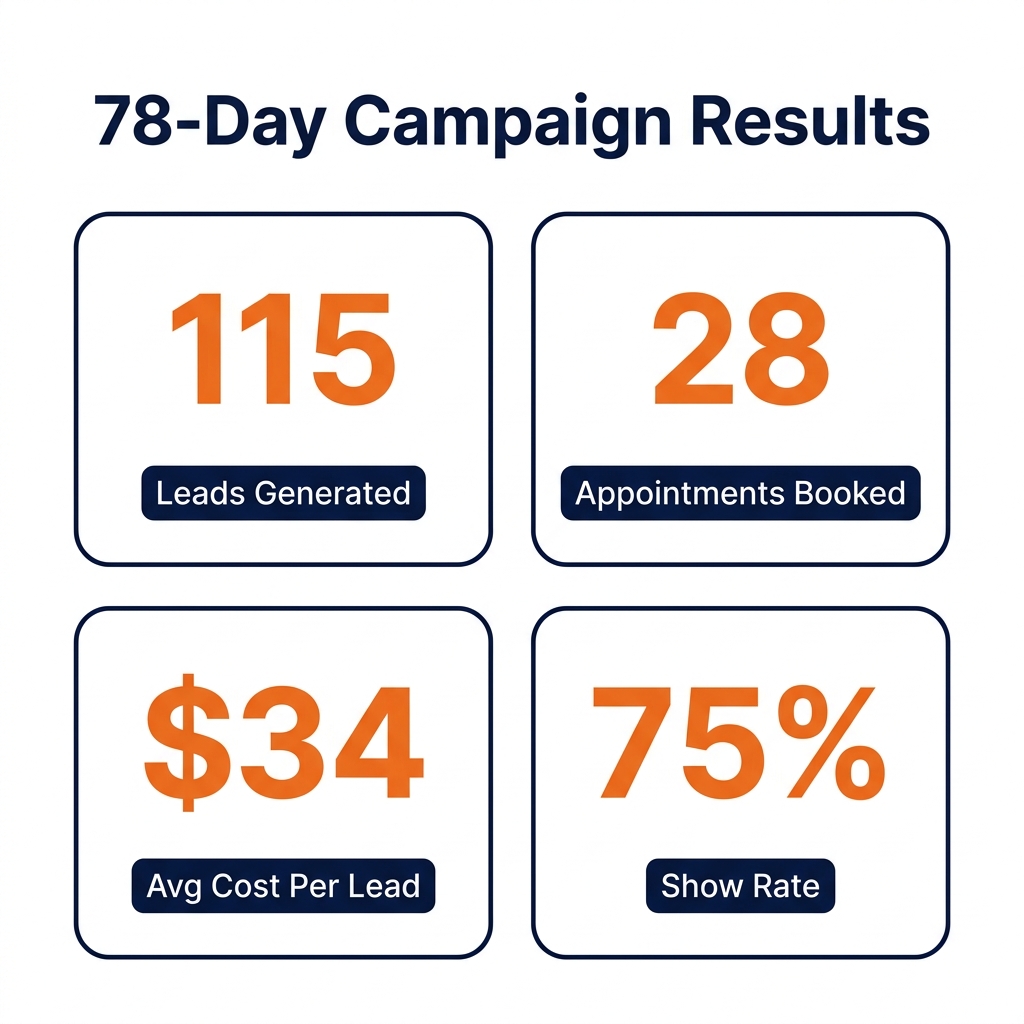
Final 78-day campaign data:
- Total leads generated: 115
- Total ad spend: ~$3,900
- Average CPL: $34
- Appointments booked: 28
- Book rate: 24%
- Appointments showed: 21
- Show rate: 75%
- Policies enrolled: ~6 (21 shows × 30% close rate)
- Close rate: 30%
That's approximately 6 MA enrollments. At $611 per enrollment in Year 1 commissions, that's $3,666 in first-year revenue — before a single renewal check.
Over 5 years, with average MA renewal rates at $306/year, each client is worth ~$1,835 in lifetime commissions. Six clients = roughly $11,010 in lifetime revenue from 78 days of campaign spend.
What Made It Work
Three things drove this result.
Speed to lead. The 5-minute contact rule is not optional. When a prospect opts in, they're warm. Every hour you wait, they cool. Sub-5-minute contact doubles your contact rate. We automate the first SMS; the setter handles the call.
One winning hook, scaled. Most agencies split-test forever and never commit. We test fast, kill losers, and scale the winner. One hook drove 70% of the booked appointments in this campaign.
GHL doing the follow-up work. Missed a call? Automated SMS goes out. No-show on appointment day? The recovery sequence fires. The system keeps working between the setter's active hours. Nothing falls through.
Our 90-Day Medicare Appointment Sprint is built around this exact system. We guarantee 25 qualified appointments in 90 days — or we keep working until you get them. Every campaign includes ad build, landing page, GHL setup, setter coverage, and weekly reporting. [Learn more about the Sprint →]
What This Means for Your Pipeline
28 appointments in 78 days isn't a lucky run.
It's what happens when lead quality, speed, and follow-up all work together.
Most agents are missing one of those three. Usually it's follow-up. The lead came in, nobody called fast enough, the prospect went cold, and the CPL looks high because the conversion never happened.
The data from this campaign is consistent with our benchmark: ~$35 CPL, 22% book rate, 75% show rate. We've seen it across multiple agents in multiple markets.
Want to See What Your Numbers Could Look Like?
Take the free 60-second assessment and get your personalized Medicare Lead Gen Roadmap. It benchmarks your current pipeline setup and shows you exactly what to fix first — free, no pitch.
[Get Your Free Medicare Lead Gen Roadmap → https://sixtyfive-leads.lovable.app/roadmap]
Frequently Asked Questions
Q: What's the average cost per booked Medicare appointment? A: At ~$35 CPL with a 22% book rate, a booked appointment costs around $159 ($35 ÷ 0.22). Factor in the 75% show rate and a showed appointment runs ~$212 ($159 ÷ 0.75). At a 30% close rate, the cost per enrolled client is ~$707 ($212 ÷ 0.30). Against a 5-year LTV of ~$1,835 per MA client, that's a 2.6x return on ad spend per enrolled client.
Q: How many Medicare leads does it take to get 25 appointments? A: At a 22% book rate, you need roughly 114 leads to book 25 appointments (25 ÷ 0.22 = 113.6). At ~$35 CPL, that's about $3,990 in ad spend. Our Sprint budgets ~$4,000 to cover the algorithm learning phase in the first two weeks when CPL runs slightly above target.
Q: What is a good show rate for Medicare appointments? A: Our benchmark is 75%. Agents running without a confirmation system typically see 45–55%. A 2-touch setter protocol — one call the day before, one text 1–2 hours before — is what moves the number above 70%.
Q: Do Medicare appointment guarantees actually work? A: They work when the system behind them is real. Our guarantee isn't marketing language — it's a contractual commitment backed by the campaign math. If we don't hit 25 qualified appointments in 90 days, we keep working at no additional charge until we do. This campaign hit 28 in 78 days. The guarantee has never been triggered.