
Medicare Agent Referral System: How to Mine Your Book of Business
Most Medicare agents are sitting on the cheapest lead source they will ever have. It is not a Facebook ad. It is not a vendor list. It is the 100, 300, or 1,000 clients already in their book of business.
A Medicare agent referral system takes that book and turns it into a steady year-round lead flow. No ad spend. No cold outreach. Just a structured way to ask the people who already trust you. Done right, it can replace half of your paid lead spend.

Why Most Medicare Agents Ignore Their Book of Business
Most agents call their clients during AEP and disappear the rest of the year. They do not ask for referrals. They do not run annual reviews. They treat the book like a renewal queue, not a growth lever.
The cost of that habit is huge. A cold lead runs ~$50 CPL. Run it through a 25% book rate and a single booked appointment costs you ~$200 ($50 ÷ 25% = $200). A referred lead from an existing client costs you nothing.
Referrals close at 2 to 3 times the rate of cold leads. They show up to appointments. They sign faster. They cross-sell easier. The agent who refuses to build a referral system is overpaying for every new client by hundreds of dollars.
The "I Don't Want to Be Pushy" Problem
The single biggest reason agents do not ask is a fear of being pushy. They worry about damaging the relationship. So they wait for referrals to "happen" on their own. They almost never do.
A real Medicare agent referral system removes the awkwardness. It is built into the annual review. It is scripted. It feels normal because it is normal. Doctors ask for referrals. CPAs ask for referrals. Medicare agents should too.
The Medicare Agent Referral System That CMS Allows
Before any system, the compliance piece. CMS has clear rules on referrals and most agents misunderstand them. Misunderstanding the rules is what scares agents away from asking at all.
Here is the simple version.
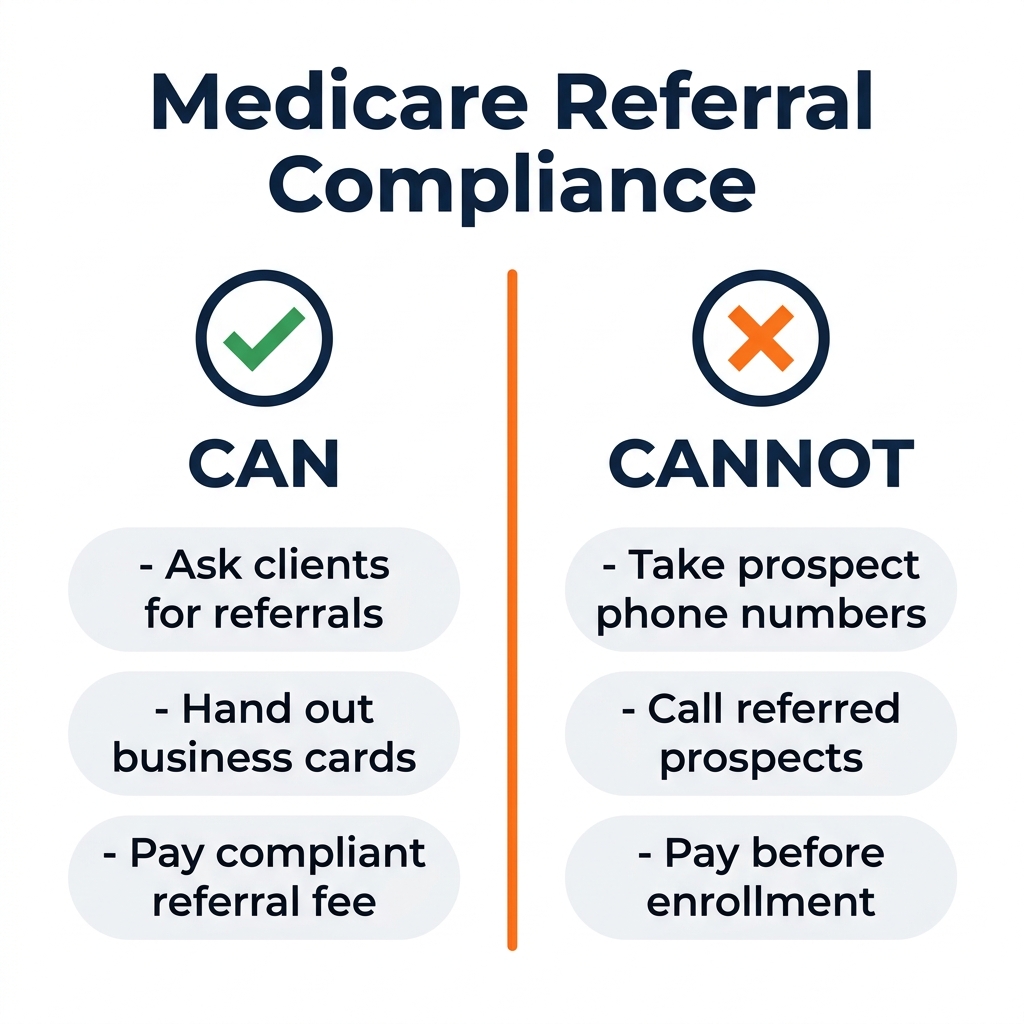
What You CAN Do
You can ask any current Medicare client if they have friends or family who could use your help. You can hand them business cards. You can run an annual review and end it with a referral ask. You can pay an unlicensed referral fee within the CMS limit. For 2026, that limit is $100 per Medicare Advantage referral and $25 per PDP referral, paid only after a successful enrollment.
You can also send branded annual review reminders to your existing book. A retention email is not marketing to a referred prospect. Your existing clients are already yours.
What You CANNOT Do
You cannot accept the phone number of the referred person from your client. You cannot then call that person directly. CMS treats that as an unsolicited telephonic communication. It is a marketing violation.
The referred prospect must contact you first. That is why the entire compliant Medicare client referral program is built around a take-home card the client hands to the prospect. The prospect calls you. You document that they reached out. The contact is now compliant.
This single rule shapes every part of the system. Build the system around it and you stay compliant by default.
5 Steps to Build a Medicare Agent Referral System That Runs Year-Round
Five steps. Each one runs without much daily effort once it is set up. The whole thing lives inside your CRM and your annual review cadence.
Step 1: The Annual Review Cadence
Every Medicare client gets a structured annual review. You schedule it 60 to 90 days before their birthday or before AEP for non-T-65 clients. The review is positioned as a benefit to them, not a sales call.
The review covers their plan, their drugs, their providers, and any life changes. It is educational. It rebuilds trust. And it ends with the referral ask.
Run the review on Zoom or by phone. Record it (with consent) for your records. The review itself is what creates the moment to ask.
Step 2: The Referral Ask Script (Compliant)
The ask is simple, scripted, and compliant. End every annual review with this:
"Most of the people I help came from clients like you. If you know anyone turning 65 or struggling with their plan, I made you a few of these cards. Give them my card. Tell them to call me when they are ready. I will take it from there."
That is it. You do not ask for names. You do not ask for phone numbers. You hand over 3 to 5 business cards. The client decides who gets them. The prospect calls you when they are ready.
This script works because it is not pushy. It positions the referral as a favor to the friend, not a favor to you. It is also fully CMS compliant because the prospect initiates contact.
Step 3: The Take-Home Card
The card is the entire compliance gate. It must include your name, your license number, your phone, and a TPMO disclaimer line. Keep it clean. The card is a tool, not a brochure.
A good Medicare agent referral system uses a card that is visually distinct from a generic business card. Some agents add a QR code that goes to a contact form on their website. Some add a short tagline like "Helping people turning 65 get the right plan."
Hand the client 3 to 5 cards in person or mail them with the annual review summary. Restock at every annual review. The cards should never run out.
Step 4: The 90-Day Touch
After the annual review, set a 90-day automated touch. A simple email or text that says you are still available for any friends or family who need help. No hard sell. Just a friendly reminder.
This is where most agents miss out. They ask once at the review and never follow up. The 90-day touch keeps you top of mind. Most referrals come 60 to 180 days after the original ask, not the same week.
A working Medicare client referral program has a touch every quarter. Birthday card. Holiday email. AEP heads-up. Every touch is a soft referral reminder without ever feeling like one.
Step 5: Track and Reward (Compliantly)
When a referred prospect calls you and enrolls, log it. You need to know which clients are sending referrals so you can thank them. A handwritten thank-you card after each successful referral is the highest-ROI marketing dollar you will ever spend.
You can also pay the CMS-compliant referral fee: $100 per MA enrollment, $25 per PDP enrollment. This is allowed. It is documented. It must be paid only after the enrollment, not before, and only to unlicensed individuals.
Track everything in your CRM. Tag the referring client. Tag the referred prospect. Run a monthly report on which clients are your top referrers. Treat them like your best business partners, because they are.
The Math: Why a Medicare Agent Referral System Beats Cold Leads
A book of 200 Medicare clients producing 1 referral per 10 clients per year equals 20 referrals. At a 50% close rate (referrals close higher than cold), that is 10 new enrollments. 10 new MA clients × $694 Year 1 = $6,940 in new commission. With 5-year LTV at $2,082 per client, that is $20,820 in long-term revenue.
Total cost: a few hours of annual reviews, a stack of business cards, and an automated email touch. Compare to cold lead spend: 10 enrollments at ~$200 cost per booked appointment plus the rest of the funnel costs. The referral system pays back inside 30 days and keeps paying for years.
This is why the highest-earning Medicare agents we work with do not chase leads. They run the book. The book runs the referrals. The referrals run the year.
What Most Agents Get Wrong About Referral Systems
Three common mistakes kill the system before it starts.
Mistake 1: Asking once and giving up. One ask at one review will not build a flywheel. The system needs the 90-day touch and the quarterly cadence to actually produce.
Mistake 2: Asking the wrong way. "Do you know anyone who needs Medicare?" gets a polite no. "Here are 3 cards. Give them to friends turning 65" gets a yes. Specific beats vague every time.
Mistake 3: Not tracking. If you do not know which clients refer, you cannot reward them. Without rewards, the flywheel slows. A 5-line CRM tag is enough. Track it from day one.
The Medicare Agent Referral System Is Step 2, Not Step 1
A referral system needs a book. If you do not have a book yet, you cannot run a referral system. You need to fill the book first, then layer in the referral system to compound it.
The agents who scale fastest do both. They run a paid lead system to fill the book and a Medicare agent referral system to multiply it. See the full 3-lever scaling system here. The two together are how you go from 100 clients to 500 without scaling your ad budget.
Want to know exactly where your Medicare lead gen is breaking down?
Take the free 60-second assessment and get your personalized Medicare Lead Gen Roadmap. It benchmarks your current pipeline setup and shows you exactly what to fix first. Free, no pitch.
Get Your Free Medicare Lead Gen Roadmap →
Or if you are ready to talk now, book a free 20-minute strategy call here. No pitch. Just a look at your market and what consistent leads could look like.
Frequently Asked Questions
Q: How do Medicare agents get referrals from their book of business?
A: A working Medicare agent referral system runs on a structured annual review, a scripted compliant ask, take-home cards the client hands to prospects, and a 90-day automated follow-up touch. Most referrals come 60 to 180 days after the original ask, not the same week.
Q: Is asking for Medicare referrals CMS compliant?
A: Yes, asking is compliant. What is not compliant is accepting the referred prospect's phone number from your client and calling them. CMS treats that as an unsolicited telephonic communication. The compliant model is: you give your client cards, the client gives them to the prospect, and the prospect contacts you first.
Q: How much can a Medicare agent pay for a referral?
A: For 2026, the CMS maximum is $100 per Medicare Advantage enrollment and $25 per Prescription Drug Plan enrollment. Paid only after enrollment is complete. Paid only to unlicensed individuals. Documented in writing every time.
Q: How many referrals can one Medicare client generate?
A: A typical Medicare client refers 1 to 2 friends or family members per year if you actually run an annual review and ask. A book of 200 clients with that ratio produces 200 to 400 referrals per year. At a 50% referral close rate, that is 100 to 200 new enrollments per year from referrals alone.