
Medicare Agent Tech Stack 2026: 5 Tools That Replace Manual Follow-Up
The Medicare agent tech stack 2026 is not about more software. It is about less manual work. Most agents are still texting leads by hand, copy-pasting into a spreadsheet, and chasing no-shows on a sticky note. That is why their pipeline stalls every January.
A real tech stack runs the boring parts in the background. The agent shows up, takes the call, and closes. Below are the 5 tools every independent Medicare agent should have running by 2026.
Why Manual Follow-Up Breaks the Medicare Agent Tech Stack
Most agents lose money in the gap between the lead coming in and the first call. The industry average for first response is around 42 hours. By then, the lead has called another agent, forgotten they filled out the form, or moved on entirely.
Studies show 50% of sales go to the vendor who responds first. In Medicare, that gap is even bigger. A 65-year-old fills out 3 forms in one afternoon. The first agent who calls within 5 minutes is the one who books the appointment.
Manual follow-up cannot hit a 5-minute response window. Not while you are on a call. Not at 8pm. Not on a weekend. The Medicare agent tech stack 2026 closes that gap automatically. This is the same automation system we map out in our Medicare appointment system pillar.
What "Automated" Actually Means
Automated does not mean robotic. It means the right message goes out at the right second, every time, without you touching anything. The agent still owns the relationship. The system owns the timing.
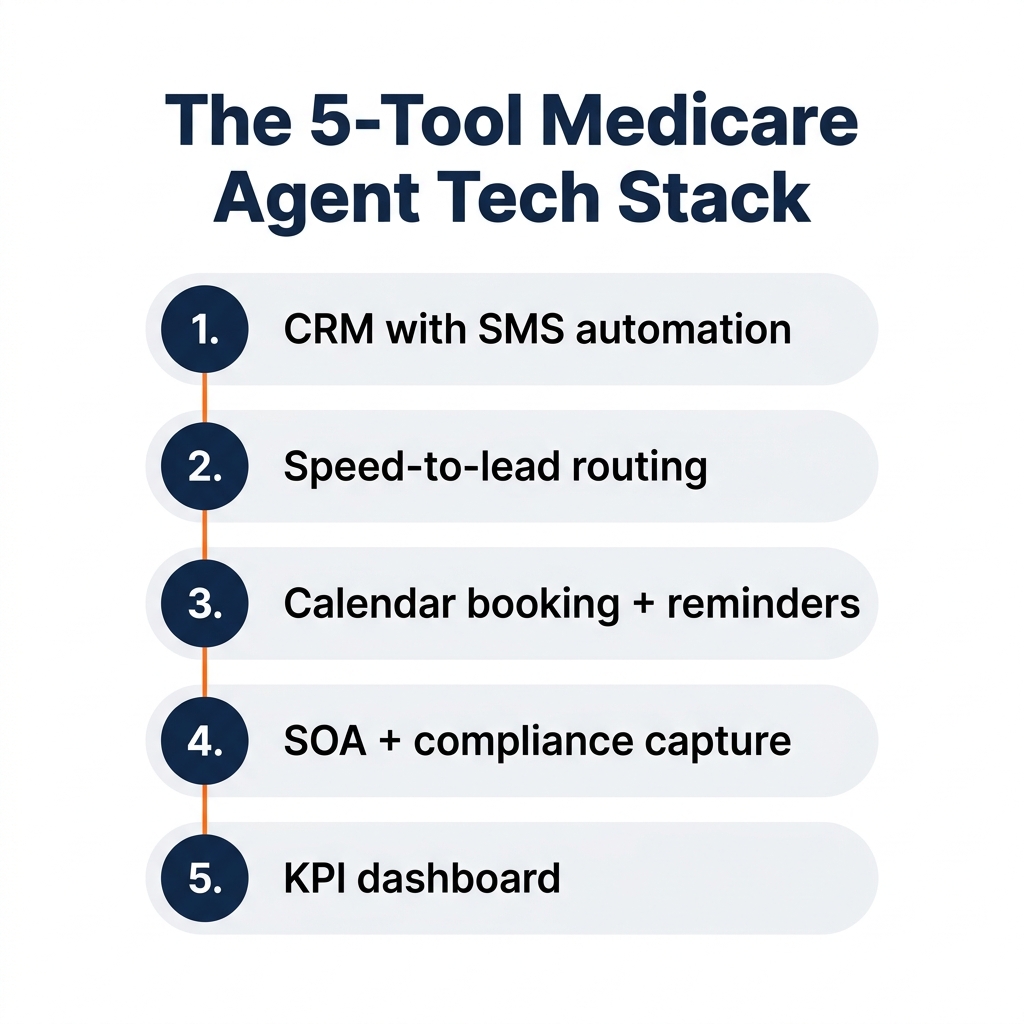
The 5 Tools Every Medicare Agent Tech Stack Needs in 2026
These are the 5 categories of tools that make up a working tech stack. You do not need 5 different vendors. Most of this can run inside one CRM if you pick the right one.
1. CRM With Built-In SMS Automation
The CRM is the spine of the entire tech stack. It holds every lead, every conversation, every appointment, and every renewal date. If the CRM cannot send an automatic SMS the moment a lead comes in, it is not a CRM. It is a contact list.
GoHighLevel (GHL) is the platform we build every client on. It has SMS, email, calendar booking, pipeline tracking, and automation triggers in one place. Other agents use AgencyBloc or Radius. The brand matters less than this rule:
The CRM must fire an SMS to the lead within 60 seconds of form submission. Without that, nothing else in the stack matters.
2. Speed-to-Lead Routing System
A lead comes in. What happens in the next 5 minutes decides whether you close that client or lose them. A speed-to-lead system is what makes those 5 minutes automatic.
In a working setup, the lead form fires a webhook to your CRM. The CRM sends an SMS, books a call slot, and texts you a link to the lead profile. All before the lead has put their phone down. That is what a Medicare lead follow-up automation system actually does.
This is the single biggest gap we see in agent businesses. Most agents already have leads. They just lose them to the agent who texted back first.
3. Calendar Booking and Confirmation Software
Phone tag kills Medicare appointments. The agent calls, leaves a voicemail, and the lead never calls back. Or the lead picks up but cannot find a time. Calendar booking software removes that friction.
A real Medicare appointment booking software setup does 4 things:
- Lets the lead pick a time on their phone in 30 seconds
- Sends an automatic confirmation text and email
- Sends a 24-hour reminder
- Sends a 1-hour reminder before the call
This is how show rates climb from the industry average around 50% to the benchmark 75%. The reminders do the work.
4. Compliance and SOA Capture
CMS rules around Scope of Appointment (SOA) are not optional. The SOA must be on file before any plan-specific conversation happens. A 2026 Medicare agent tech stack handles this automatically.
The lead books the call. The CRM fires an email with the SOA link. The lead signs it on their phone. The signed document hits your CRM before the call even starts. Tools like SunFire, Connecture, and the SOA workflow inside GoHighLevel all handle this.
This is also where TPMO disclaimers live. The same automation that captures SOA also stores the TPMO disclosure on every ad and landing page touchpoint. Compliance becomes a system, not a worry.
5. Reporting and KPI Dashboard
You cannot fix what you cannot see. Most agents run on gut feel. They think they have a "show rate problem" but they actually have a "lead quality problem." A KPI dashboard tells you which one is true.
The 5 numbers that matter for an independent Medicare agent in 2026:
- CPL — cost per lead (target: ~$50)
- Book rate — leads to booked appointments (target: 25%)
- Show rate — booked to showed appointments (target: 75%)
- Close rate — showed to enrolled (target: 40% on qualified meetings)
- Day-1 close value — first appointment revenue including cross-sell (target: $900+)
When all 5 are visible on one dashboard, problems show up before they cost you a quarter. GHL has this built in. So does AgencyBloc. The tool matters less than the discipline of looking at the numbers every Monday.
How the Medicare Agent Tech Stack 2026 Replaces Manual Follow-Up
Here is the workflow with all 5 tools running together. This is what the day looks like for an agent on a working tech stack.
A lead fills out a form at 9:14am. By 9:14:45am, they have a confirmation text. By 9:15am, they have booked a 2pm call. By 9:16am, they have signed the SOA. The agent gets one notification: "New appointment booked, SOA on file, lead profile attached."
The agent does not chase. The agent does not text back. The agent shows up at 2pm to a confirmed, prepared, compliant lead. That is the point of the entire stack.
The 2-touch reminder system fires at 2pm the day before and 1pm the day of. The lead shows up. The dashboard updates the show-rate number automatically. If the lead does not show, the no-show recovery sequence fires automatically and tries to reschedule within the next 48 hours.
This is not theoretical. This is how a single Medicare agent runs a 40-appointment-per-month pipeline without an assistant. The tech stack is the assistant.
What a Working Medicare Agent Tech Stack Costs
Most agents overspend on the wrong tools and underspend on the right ones. Here is the realistic breakdown.
A full GoHighLevel for Medicare agents setup runs around $97 to $297 per month depending on which tier and add-ons. SOA capture tools add $50 to $150 per month if not bundled. A solid call recording and dialer setup adds another $50 to $100. Total: roughly $200 to $500 per month for everything.
Compare that to the cost of one missed appointment. At ~$50 CPL and a 25% book rate, every booked appointment cost you ~$200. Lose 3 appointments to manual follow-up gaps in a month and the tech stack just paid for itself 3 times over.
The math gets stronger when you factor in lifetime value. A single Medicare Advantage client is worth $694 in Year 1 commission and around $2,082 over 5 years. Save 1 client per month and the entire tech stack pays for the year.
Where Most Medicare Agent Tech Stacks Break Down
We see the same 3 mistakes when we audit agent tech stacks. They are usually fixable inside a week.
Mistake 1: The lead source is broken upstream. A perfect tech stack with shared, recycled, 30-day-old leads still loses. Garbage in, garbage out. The tech stack only multiplies what it gets fed.
Mistake 2: The agent built the system but never tested it. The webhook is not firing. The reminder text is going to the wrong number. The SOA link is broken on mobile. Test every workflow end-to-end with a fake lead at least once a quarter.
Mistake 3: No one is watching the dashboard. A tech stack that nobody looks at is just expensive software. The Monday KPI review is what makes the stack pay back.
The Medicare Agent Tech Stack 2026 Starts With the Lead Source
The best CRM in the world cannot save a bad lead source. That is why we always solve the lead side first, then the system side.
Our 30-Day Lead Sprint is built around this exact stack. We deliver 25 exclusive, SMS-verified, T-65 leads in 30 days, fully integrated with the GHL automations above. Each lead answers 11+ screening questions and confirms via SMS before delivery. Learn more about the Sprint here.
Once the lead source is exclusive and real-time, every tool in the tech stack starts paying back. Until then, the stack is just plumbing for cold water.
Want to see exactly how we generate 25 exclusive T-65 leads in 30 days and route them through this exact tech stack?
We put together a short video that walks through the whole system. How the leads are generated. How they are qualified. What happens after they hit your CRM.
Or if you are ready to talk now, book a free 20-minute strategy call here. No pitch. Just a look at your market and what consistent leads could look like.
Frequently Asked Questions
Q: What CRM do Medicare agents use in 2026?
A: Most independent Medicare agents in 2026 use GoHighLevel, AgencyBloc, or Radius. GoHighLevel is the most common in the lead-gen-driven Medicare agent tech stack 2026 because it bundles SMS, email, calendar booking, and pipeline tracking in one platform.
Q: How do Medicare agents automate lead follow-up?
A: Medicare lead follow-up automation works by firing an SMS within 60 seconds of form submission, sending the lead a calendar booking link, capturing the SOA on the lead's phone, and triggering 24-hour and 1-hour reminders. All of this runs inside the CRM with no manual work from the agent.
Q: How much does a Medicare agent tech stack cost?
A: A full Medicare agent tech stack runs roughly $200 to $500 per month including CRM, SMS automation, calendar booking, SOA capture, and reporting. The savings from automated follow-up usually cover the cost within the first 3 booked appointments saved per month.
Q: What tools replace manual follow-up for Medicare agents?
A: The 5 tools that replace manual follow-up are a CRM with built-in SMS, a speed-to-lead routing system, calendar booking software with confirmation reminders, SOA capture for compliance, and a KPI dashboard. Together they handle every step from lead-in to enrollment without the agent typing a single text.