
Medicare Appointment Setter Leads: The Missing Piece
A Medicare appointment setter without leads is a car with no gas. The engine is built. The system is ready. Nothing moves.
If you have a setter in place and your pipeline is still inconsistent, the problem is almost never the setter. It is almost always the Medicare appointment setter leads — specifically, the volume and quality of what comes in each week.

What Happens When Medicare Appointment Setter Leads Stop Coming
A setter's one job is to take an opted-in lead, make contact fast, and book the appointment. That is a narrow function. When leads come in consistently, a good setter converts at 22% or better. When lead flow turns unpredictable — feast one week, nothing the next — everything breaks downstream.
Book rate drops. The setter loses rhythm. Appointments come in waves instead of steadily. Your calendar fills for a week, then goes quiet for two.
The agents who get the most from their setter system are not the ones with the best scripts. They are the ones who solved the lead flow problem first.
The Cost of Running a Setter on Empty
Here is the math most agents skip.
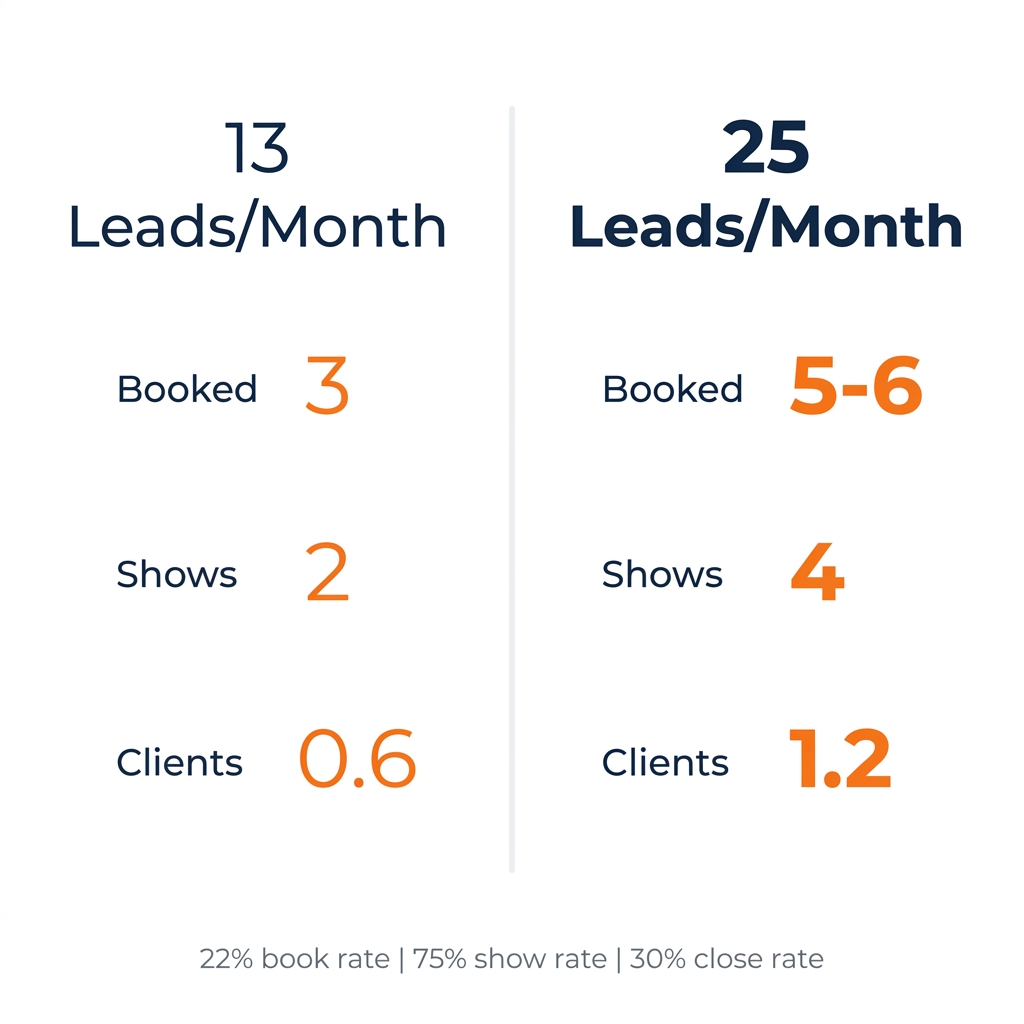
A setter working 25 Medicare appointment setter leads per month, at a 22% book rate, books 5 to 6 appointments. At 75% show rate, that is about 4 shows. At a 30% close rate, that is roughly 1.2 new clients per month.
Now cut the lead volume in half. Thirteen leads instead of 25.
Booked appointments drop to fewer than 3. Shows drop to about 2. Enrolled clients: less than 1 per month.
The difference is not dramatic-looking week to week. But over 12 months, running at half lead volume costs you approximately 6 to 7 clients you never enrolled. At $611 each in Year 1 MA commissions, that is $3,000 to $3,700 left on the table in Year 1 alone. At $1,835 in five-year lifetime value per client, the real number is closer to $9,000 to $11,000 in lost lifetime value.
The setter is not the bottleneck. The lead volume is.
Why Most Agents With Setters Still Run Out of Leads
Shared Leads Break the Setter System
Shared leads feel like a volume solution. They are cheaper per lead, so agents buy more and send them to the setter.
The problem: shared leads get sold to 3 to 5 agents simultaneously. By the time your setter calls, two other agents have already left voicemails. Contact rate on shared leads runs around 10%. Your setter spends most of their time chasing people who have already tuned out.
A setter optimized for Medicare appointment setter leads needs exclusivity and speed. Shared leads undermine both.
Why Referrals Do Not Replace Medicare Appointment Setter Leads
Referrals are the best kind of lead. They are also the hardest to control. You can ask for referrals every week and still have a dry month. Organic search traffic takes 3 to 6 months to produce consistent volume.
Neither of these gives you a lever you can pull on demand. A setter system needs a predictable, adjustable lead source — something you can turn up when capacity allows and dial back when the calendar is full. Referrals and organic alone cannot do that.
What Consistent Medicare Appointment Setter Leads Build Over 12 Months
Twenty-five exclusive, hand-raised leads per month is enough to run a setter system at consistent output. Here is what that produces.
25 leads per month at 22% book rate at 75% show rate at 30% close rate = 1.2 new clients per month.
Over 12 months: approximately 14 new Medicare Advantage clients.
First-year commissions: 14 clients at $611 each = approximately $8,500.
Five-year lifetime value: 14 clients at $1,835 each = approximately $25,700.
That is what one steady stream of Medicare appointment setter leads produces when a system is on the other end ready to work them. Most agents with setters are sitting close to that system. They just are not feeding it consistently.
For the full breakdown on building and running a Medicare appointment pipeline, the pillar post covers the complete system here.
How to Feed Your Setter Consistently
Three things determine whether your Medicare agent lead flow actually works:
- Exclusivity. The lead opts in and comes to you only — not a shared list, not aged data. One agent. First contact, every time.
- Volume control. You decide how many leads hit the pipeline each week based on your setter's actual capacity. Not so many they pile up. Not so few the momentum stalls.
- Speed to first contact. Your setter makes contact within 5 minutes of opt-in. After that window, contact rate drops fast regardless of how good the lead is.
The Medicare Lead Sprint is built for exactly this scenario. You have the system. We provide the fuel: exclusive, real-time, SMS-verified leads delivered into your GHL pipeline as they opt in. Your setter gets first contact every time. See how consistent Medicare appointment setter leads change the math.
Your Setter Is Ready. Give It Something to Work With.
You built the system. The setter is in place. GHL is configured. The only thing standing between where you are and consistent enrolled clients is a reliable, exclusive lead source coming in every week.
Take the free 60-second assessment and get your personalized Medicare Lead Gen Roadmap.
It shows you exactly how many leads your setup needs to hit your income goal — and where the gaps are. Free, no pitch.
Get Your Free Medicare Lead Gen Roadmap
Or if you are ready to talk now, book a free 20-minute strategy call. No pitch. Just a look at your market and what consistent exclusive leads could look like for your setter.
Frequently Asked Questions
Q: How many Medicare appointment setter leads do I need per month?
A: Most setter systems run efficiently on 25 exclusive leads per month. At a 22% book rate, that produces 5 to 6 appointments per month — enough to keep a part-time setter fully productive. Scale to 40 to 50 leads per month for a full-time setter or larger team.
Q: Why does my Medicare appointment setter have a low book rate?
A: Low book rate on Medicare appointment setter leads almost always comes down to two things: lead exclusivity and speed to first contact. Shared leads arrive after 2 to 4 other agents have already called. Exclusive leads — especially real-time, hand-raised leads — produce much higher contact rates and drive book rate up toward 22%.
Q: What is the difference between exclusive and shared leads for a setter?
A: Exclusive Medicare leads go to one agent only. Your setter is the first and only contact. Shared leads go to 3 to 5 agents at the same time. By the time your setter calls a shared lead, the prospect has often already spoken with a competitor. Exclusivity is the single biggest driver of setter efficiency.
Q: Can I run a Medicare setter system without a CRM like GHL?
A: Technically yes, but you lose most of the value. The setter system works because of speed — automation triggers first contact within 5 minutes of opt-in. Without a CRM handling that, your setter checks for new leads manually and calls hours later. GHL automation is what makes the timing reliable enough to hit 22% book rate consistently.