
Medicare Appointment Setter Process: 75% Show Rate
A working Medicare appointment setter process is the difference between a 48% show rate and a 75% show rate. Most agents lose half their booked appointments before the call even starts. The fix is a system, not better leads.

What a Medicare Appointment Setter Process Actually Does
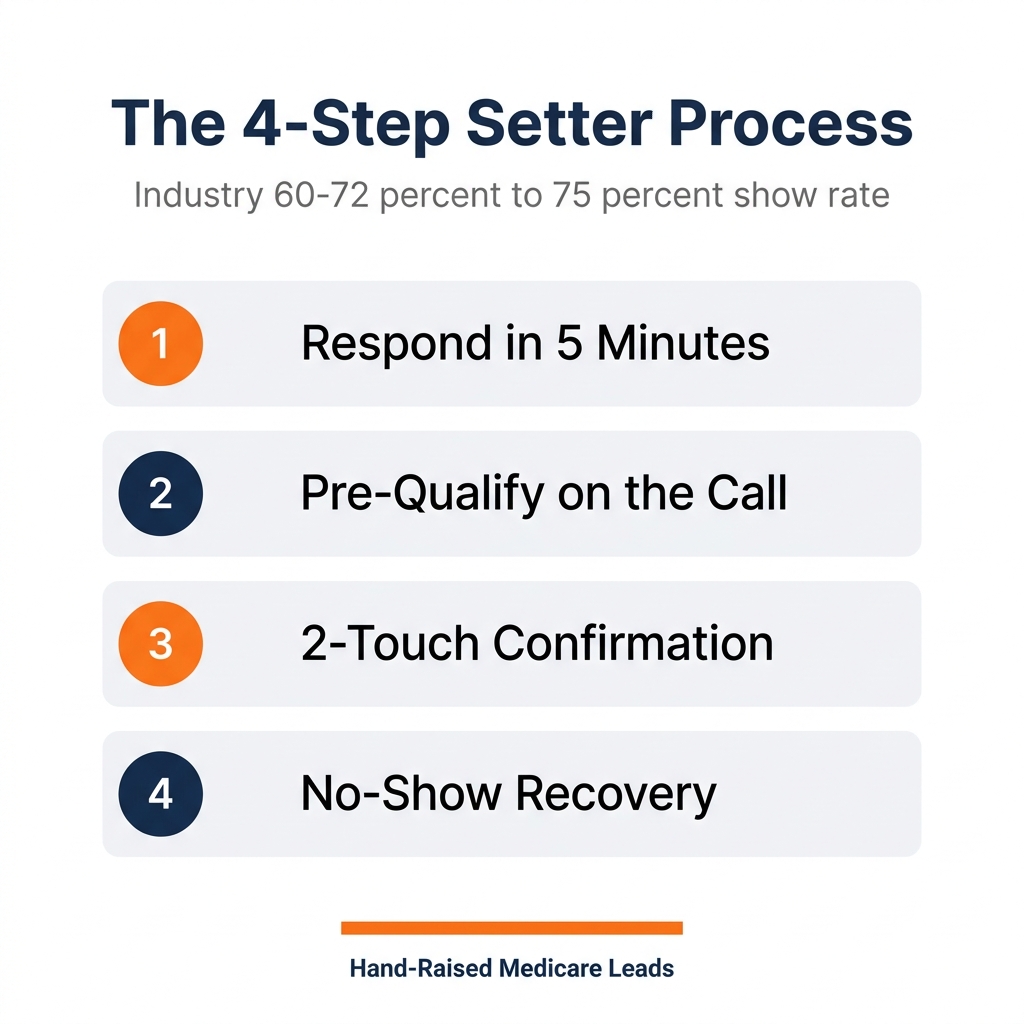
A Medicare appointment setter process is the step-by-step workflow that turns a fresh lead into a showed appointment. It covers four things: speed of contact, pre-qualification, confirmation, and no-show recovery.
Most agents skip three of the four. They contact fast, then forget about the lead until appointment day. That is why their show rate sits at 50% while ours sits at 75%.
The industry average insurance appointment show rate is 60 to 72 percent. The 75 percent benchmark is achievable, but only with all four steps running.
Why a Strong Medicare Appointment Setter Process Compounds
If you book 20 appointments at a 50% show rate, you ran 10 calls. If you book the same 20 appointments at a 75% show rate, you ran 15 calls. Same leads, same booking effort, 50% more pipeline.
That gap compounds. Over a 90-day campaign, a 75% Medicare appointment setter process produces 15 more showed appointments per 100 booked. At a 40% close rate, that is 6 more enrolled clients. The system pays for itself.
Step 1: The 5-Minute Response Window
Every Medicare appointment setter process starts with speed-to-lead. The MIT Lead Response Study showed leads contacted within 5 minutes are 21 times more likely to qualify than leads contacted after 30 minutes.
For 5-minute response Medicare leads, every second past 5 minutes drops the qualification rate by roughly 10 percent. Wait an hour and the lead is effectively dead.
Why 5 Minutes Is the Cutoff
Medicare leads are shopped. Even exclusive leads have urgency built in. A T-65 prospect who fills out a quiz is doing the same thing on three other sites that hour. The first agent to respond is the only one who matters.
For shared leads, it gets worse. Shared leads are sold to 3 to 8 carriers simultaneously. The first to call wins. Everyone else is calling a "Why are you calling me again?" lead.
What Speed-to-Lead Looks Like in GHL
The 5-minute rule is not a goal. It is an automation. In GHL, a new lead triggers three things at once: an SMS, an email, and a setter notification. The setter calls within 5 minutes, not 5 hours, not the next business day.
Only 0.1 percent of businesses respond within 5 minutes industry-wide. That is your edge.
Step 2: The Pre-Qualification Conversation
Once you reach the lead, the Medicare appointment setter process moves to qualification. This is not a sales pitch. The setter's only job is to confirm fit and book the appointment.
A good Medicare setter script runs 4 to 6 minutes max. It pre-qualifies on five things: age eligibility, current coverage, state of residence, decision timeline, and willingness to take a call.
The 11-Question Screening
Our 30-Day Lead Sprint uses an 11-question funnel before the lead is ever delivered. By the time the setter calls, age, state, and Medicare eligibility are already confirmed. The setter only has to confirm timing and book.
That is what makes a hand-raised lead different. The lead has already replied to an SMS and answered 11 screening questions. They are warm, not cold.
What to Confirm Before Booking
Before any Medicare appointment confirmation, the setter verifies five things on the call:
- Age 64 or older (or qualifying disability or ESRD)
- Lives in your licensed state
- Not already enrolled with another agent this AEP cycle
- Available for a 30-minute call on the booked time
- Has a calendar to add the invite
If any one of these fails, the appointment does not get booked. Booking unqualified leads is the fastest way to crater a show rate.
Step 3: The 2-Touch Confirmation Framework
This is the step most agents skip. After the appointment is booked, a Medicare 2-touch confirmation system runs automatically. It is the single biggest show rate lever.
Industry data shows multi-touch confirmation systems with 24-hour and 1-hour reminders maximize appointment attendance. We use a 2-touch sequence: call plus text.
Touch 1: 24 Hours Before
The day before the appointment, the setter sends a short text and an optional confirmation call. The text reads:
"Hi [name], confirming your call with [agent] tomorrow at [time]. Reply Y to confirm or call/text us back if you need to reschedule."
If the lead replies Y, they show at much higher rates. If they reply with a reschedule, you save the appointment instead of losing it to a no-show.
Touch 2: 1 to 2 Hours Before
A short text the same day. Different copy, same purpose:
"Quick reminder, your Medicare review with [agent] starts in about an hour. Talk soon. Reply STOP to cancel."
This is the touch that catches the "I forgot" no-shows. Most people show because someone reminded them in the same window they would have stood you up.
Together, the 2-touch confirmation system moves show rate from 50 percent to 75 percent. Same booking effort. No new leads. Just a process.
Step 4: The 4-Step No-Show Recovery System
Even with the best Medicare appointment setter process, some leads will no-show. The recovery system decides whether you lose them or save them.
We run a 4-step Medicare no-show recovery sequence. Each step has a script and a time window.
The 5-Minute No-Show Call
If the appointment is 5 minutes past start time and the lead has not joined, the setter calls immediately. Script A. The tone is curious, not accusatory. "I had us on the calendar for 2pm, are you running behind?"
A surprising percentage of no-shows pick up on this call. They forgot, they are in traffic, they are at the doctor. You save the appointment in real time.
The Same-Day Text
If the call goes to voicemail, send a same-day text. Script B. Short. Non-pushy. "No worries if today did not work. Want me to grab a new spot for later this week?"
That message recovers the lead without burning the relationship.
Same-Day Reschedule vs Next-Day
The next two steps depend on response timing. If the lead replies within a few hours, offer a same-day reschedule. Same energy, no extra cooldown. If they reply the next day, run a fresh confirmation sequence for the new appointment.
The full Medicare no-show recovery sequence saves roughly 1 in 3 no-shows. On 12 no-shows worked, about 4 reschedule and show. At the 40 percent close rate, that converts to roughly 1 to 2 additional enrollments you would have lost without the sequence.
For the broader system this connects to, read our Medicare appointment system pillar guide. It walks through how the setter process plugs into the full pipeline.
Why This Medicare Appointment Setter Process Hits 75% Show Rate
It is not magic. It is four steps running in order, every time, automated where possible. Speed-to-lead in 5 minutes. Pre-qualification before booking. 2-touch confirmation in the 24 hours before. No-show recovery the moment the appointment slips.
Agents who follow all four steps consistently hit 75% show rates. Agents who skip even one drop to 50 to 60 percent, the industry average. The Medicare appointment setter process is the system. The 75% number is the output.
For the deeper playbook on cutting no-shows specifically, see how to reduce Medicare appointment no-shows by 30%.
Want to know exactly where your Medicare appointment setter process is breaking down?
Take the free 60-second assessment and get your personalized Medicare Lead Gen Roadmap. It benchmarks your current setter, confirmation, and recovery workflow against the 75% show rate standard. Free, no pitch.
Frequently Asked Questions
Q: What does a Medicare appointment setter process look like?
A working Medicare appointment setter process has four steps: 5-minute response to fresh leads, pre-qualification on the first call, a 2-touch confirmation sequence before the appointment, and a 4-step no-show recovery system. Agents who run all four steps consistently hit 75 percent show rates.
Q: How do you reach a 75% show rate on Medicare appointments?
A 75% show rate comes from the 2-touch confirmation system more than any other factor. Send a confirmation text 24 hours before the appointment and a second reminder 1 to 2 hours before. Combined with 5-minute speed-to-lead and pre-qualification, this stack moves show rate from the industry-average 60 to 72 percent up to 75 percent.
Q: What is the 5-minute rule for Medicare leads?
The 5-minute rule says you must contact a Medicare lead within 5 minutes of opt-in. MIT data shows leads contacted in under 5 minutes are 21 times more likely to qualify than leads contacted after 30 minutes. Only 0.1 percent of businesses respond inside the 5-minute window. That gap is your competitive advantage on speed to lead Medicare prospects.
Q: What is a 2-touch confirmation system for Medicare appointments?
A Medicare 2-touch confirmation is two automated reminders before each appointment. Touch 1 is a text and optional call 24 hours before, asking for a "Y" reply to confirm. Touch 2 is a short text reminder 1 to 2 hours before. Industry research shows multi-touch confirmation systems maximize appointment attendance and lift show rate by 15 to 25 points.