Are Annuity Seminars Still Effective in 2026?
Are annuity seminars still effective? Yes, for some advisors. But the published numbers have moved, and most advisors have never run the full funnel math on their own events.
Here is what the data says, and where the model breaks.
Are Annuity Seminars Still Effective, or Just Familiar?
Both things are true at once, which is why the question keeps getting argued.
Seminars still produce clients. Advisors who run them on a structured, repeatable system still fill rooms and write business.
At the same time, published reporting says dinner seminar attendance has dropped into the 20 to 30 percent range, with conversion rates flat. The prospect pool that reliably answered direct mail invitations has aged, shrunk, and grown more skeptical.
So the honest answer is not yes or no. It is that the channel still works, and it works less well than it did, and the only way to know if it still works for you is to run your own numbers.
So ask a better question. Not "do seminars work," but: what does one qualified appointment cost me through this channel, compared to the others I could run?
That reframes it from a belief into arithmetic. Most advisors have never done that division.
What the Published Seminar Numbers Show
Four benchmarks define the funnel. All four come from published advisor marketing sources, not from us.
Seminar Response Rate
The published seminar response rate for direct mail invitations is roughly 0.4 to 1 percent, assuming best practices are followed.
That is the number every other number depends on. Mail 5,000 households and you are working with 20 to 50 responses. A seminar response rate below that range makes every downstream figure worse.
No-Show Rate
Of those who register, 15 to 20 percent do not show up when the lead came from a mailer.
If the registration came from social media or search ads instead, published no-show rates run as high as 60 percent. That gap matters if you are tempted to fill seats with cheaper digital traffic.
Appointment Set and Close Rates
The stated goal for setting appointments from the room is 50 percent. The reported average is closer to 40 percent.
From there, roughly 30 percent of first office appointments close. Referral-sourced first appointments close at about 50 percent, which is a useful reminder of what the room is actually competing against.
The Full Annuity Seminar Funnel, Start to Finish
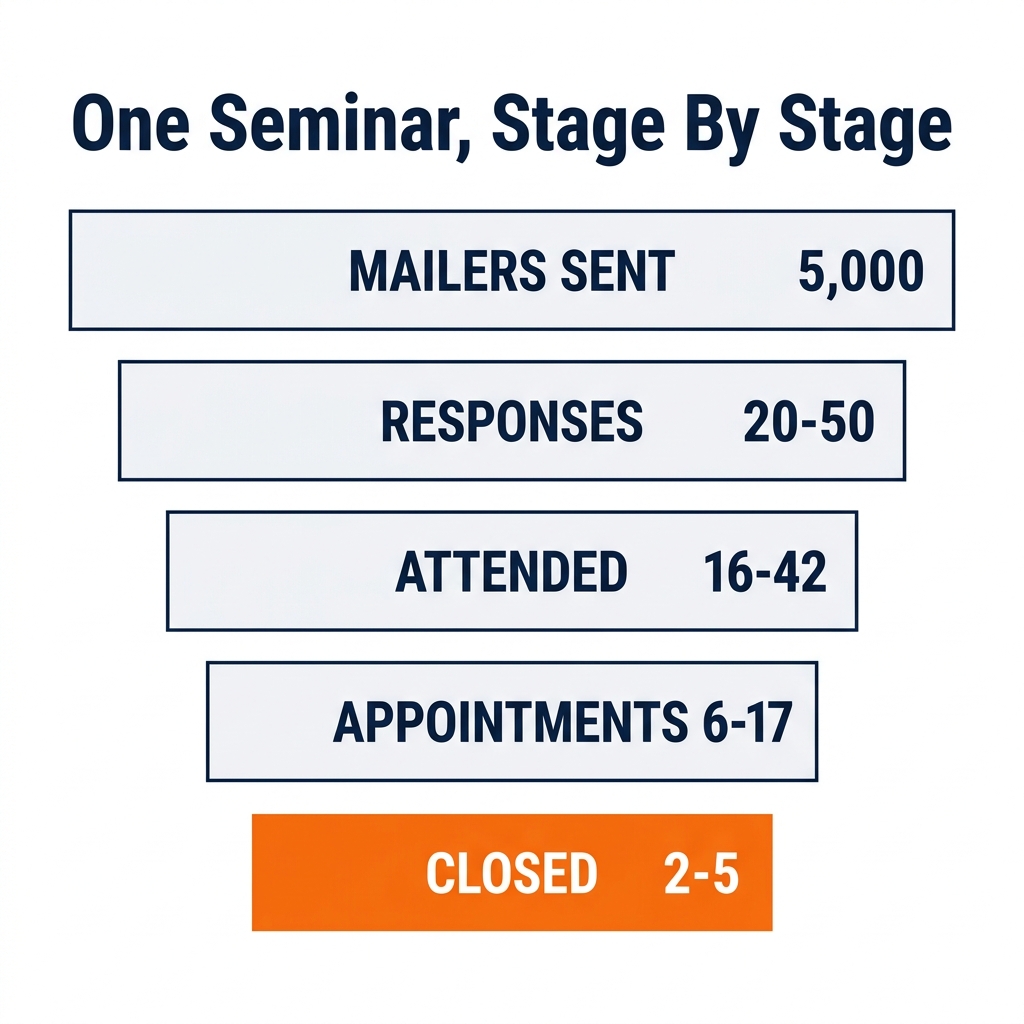
Chain those four benchmarks together on a 5,000-piece mailer. This is arithmetic on published rates, not a projection.
| Stage | Rate applied | Result |
|---|---|---|
| Mailers sent | n/a | 5,000 |
| Responses | 0.4% to 1% | 20 to 50 |
| Attended | 80% to 85% show | ~16 to ~42 |
| Appointments set | 40% | ~6 to ~17 |
| Closed | 30% | ~2 to ~5 |
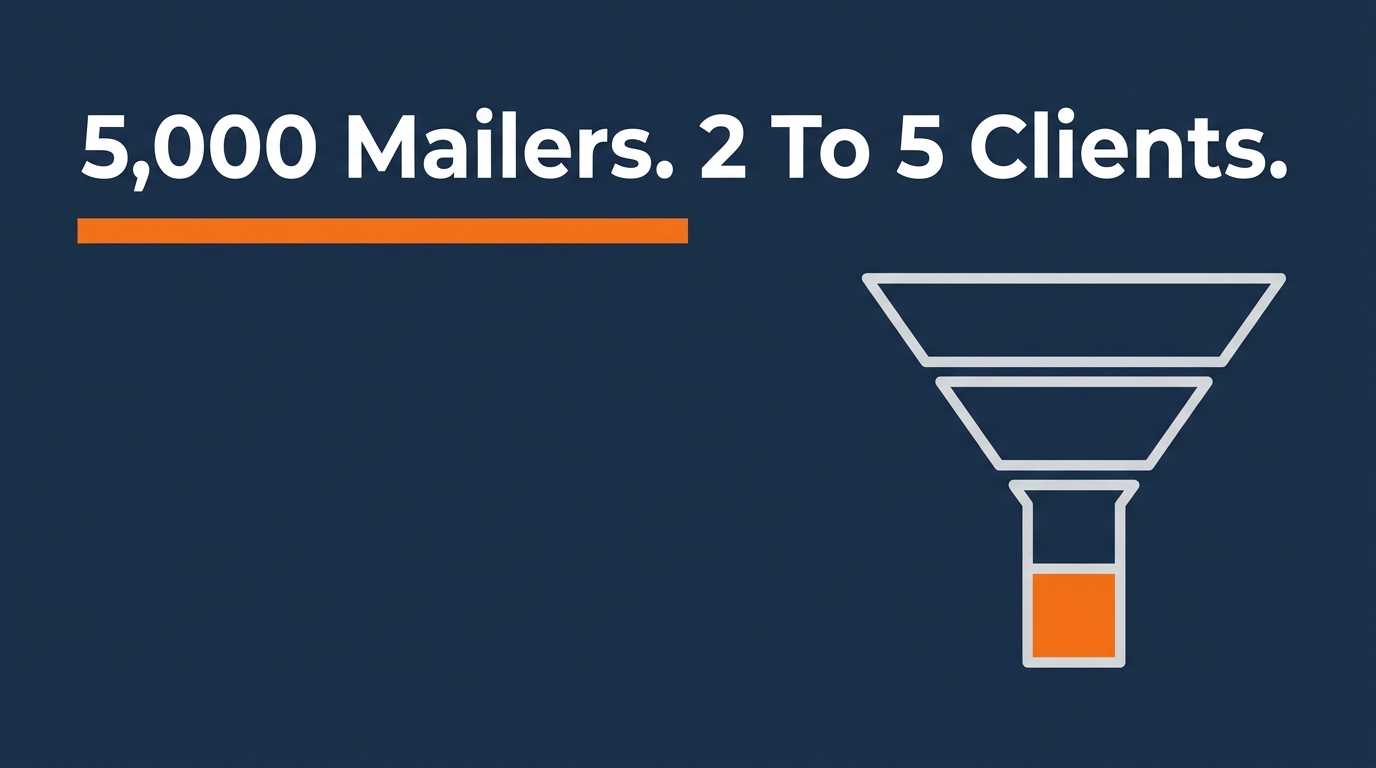
One event, run competently, produces roughly 2 to 5 new clients.
That is not a bad outcome. It is also a much narrower funnel than most advisors picture when they book the room.
Now Divide by Cost
Published seminar costs run $3,000 to $16,000 per event, with a common breakdown of about $5,000 for the mailing and $2,000 for the dinner.
Take $8,000 as a mid-range event. Against the appointment range above:
- $8,000 ÷ 17 appointments = about $470 per appointment (best case)
- $8,000 ÷ 6 appointments = about $1,333 per appointment (worst case)
So the cost per annuity appointment from a single event lands somewhere between $470 and $1,333. That is a nearly threefold spread on the same event, driven almost entirely by response rate and show rate. Neither of which you control on the night.
And none of that counts your evening. An evening presenting is an evening. If you do not put a number on your own time, you are not measuring the channel, you are measuring the invoice.
Why Annuity Seminar Effectiveness Is Declining
Two reasons, and only one of them is about the market.
The Pool Aged and Got Harder to Reach
The households that reliably responded to a mailed invitation are older, fewer, and more skeptical than they were a decade ago. Response rates below one percent leave very little room for that pool to shrink further.
The Filter Still Runs Last
This is the structural one, and it does not improve with a better mailer.
You pay for the list, the mail, the venue and the food before you learn who in the room has money that can actually move. Qualification happens at the table, after every dollar is already spent.
That sequence is the whole problem. It is not a matter of running the seminar better.
Move the filter to the front and the same budget behaves completely differently. That is the argument we lay out in full in our guide to annuity appointment setting for advisors.
The 24/7 Rollover Pipeline is built on exactly that idea. We build the ads, the funnel, the asset qualification and the CRM inside your own accounts, then run all of it. Prospects confirm investable assets before they ever reach your calendar. Your ad account, your card, your pixel, your audiences.
What Advisors Are Moving To Instead
Three shifts show up repeatedly in the reporting.
Lunch Instead of Dinner
Lunch seminars are reported as equally or more effective than dinner events, at a fraction of the cost. Same structure, smaller bill, and it filters for a slightly different attendee.
If you are committed to the room, this is the cheapest improvement available.
The Webinar Funnel
The second annuity seminar alternative is the automated webinar funnel, described in the reporting as the modern equivalent of the dinner seminar. No venue, no food, no geographic ceiling, and it runs whether or not you are in the room that night.
Qualifying Before the Meeting
The third annuity seminar alternative is the one that changes the arithmetic. The shift is not the format, it is moving qualification ahead of spend.
A prospect answers questions about where their money sits, roughly how much of it can move, and what they want it to do. Below the floor, they never become an appointment. Above it, a person confirms it on the phone before anything lands on your calendar.
Investable means investable. Not the house, not the equity in the house, not what they think the business is worth.
How to Decide Whether Annuity Seminars Are Still Effective for You
Do not decide from an article, including this one. Decide from your last four events.
Add the total spend across those four. Count the appointments that actually showed with assets you could work. Divide.
If that number beats what your other channels produce per qualified appointment, keep running seminars. If it does not, you now know what the room is costing you, and you can compare it honestly against a filter-first alternative.
This article is written for licensed insurance and financial professionals. It is not a solicitation to consumers and it is not financial advice.
If you are already spending on marketing every month, this is worth 15 minutes.
If you are not spending yet, it is not for you and I will say that on the call rather than sell you a build you cannot feed.
One advisor per territory.
Frequently Asked Questions
Are annuity seminars still effective in 2026?
They still produce clients for advisors who run them on a structured system, but published reporting shows dinner seminar attendance has fallen to roughly 20 to 30 percent with flat conversion. Whether annuity seminars are still effective for your practice depends on your own cost per qualified appointment compared to your other channels. Run the division on your last four events before deciding.
What is a good response rate for an annuity seminar mailer?
Published benchmarks put direct mail seminar response at roughly 0.4 to 1 percent when best practices are followed. On a 5,000-piece mailer that is 20 to 50 responses. Expect a further 15 to 20 percent no-show rate from mailer-sourced registrations, and up to 60 percent if the registrations came from social or search ads.
How much does an annuity seminar cost an advisor?
Published figures put seminar costs at $3,000 to $16,000 per event, with a common split of about $5,000 for the mailing and $2,000 for the dinner, plus the venue. At a mid-range $8,000 event, the published funnel rates work out to roughly $470 to $1,333 per appointment depending on response and show rate.
What is replacing dinner seminars for annuity advisors?
Three things show up consistently: lunch seminars, which are reported as equally or more effective at lower cost, automated webinar funnels, and filter-first digital campaigns that qualify a prospect's investable assets before an appointment is ever booked. The common thread in the third option is that qualification happens before the spend rather than at the dinner table.