
Who Owns the Ad Account? What Advisors Should Ask
Who owns the ad account is the least interesting question in your marketing relationship until the day it ends. Then it becomes the only one that matters.
Most advisors have never asked it. Here is what the answer decides.
Who Owns the Ad Account, and Why Advisors Never Check
Ad accounts live inside a Meta Business Manager. Somebody's name is on that Business Manager. It is either yours or your agency's.
That single fact decides what walks out the door when the relationship ends. Not the contract language about deliverables. Not the reporting dashboard. The account.
If the agency's Business Manager holds it, the pixel history, the conversion data and the audiences you spent months building sit inside a company that is no longer working for you.
The Part That Surprises People
Most advisors assume they own it because they are paying for it. Paying the invoice and holding the asset are two different things.
Ad accounts are generally owned by the Business Manager that pays the platform. If your agency is billed by Meta and invoices you afterward, that is their account, not yours.
Meta's Own Guidance Says the Agency Should Own It
This is the part almost nobody in the advisor space knows, and it is why the question is genuinely contested rather than obvious.
What Meta Actually Recommends
Meta's published Business Manager and agency best practices tell agencies to create the ad account inside their own Business Manager and grant partner access to the client. The client is told to create the Pages, pixels, catalogs and apps in their Business Manager, then grant the agency partner access to those.
So Meta splits it. Agency holds the ad account. Client holds the pixel and the Page.
Why That Guidance Exists
It is a billing and support convenience. The platform wants the paying entity and the account holder to be the same, because that simplifies invoicing and account recovery.
That is a reasonable goal for Meta. It is not a reasonable goal for you.
Plenty of practitioners argue the opposite, and their reasoning is about what happens at the end of the relationship rather than what is convenient during it.
What You Lose When the Answer Is Not You
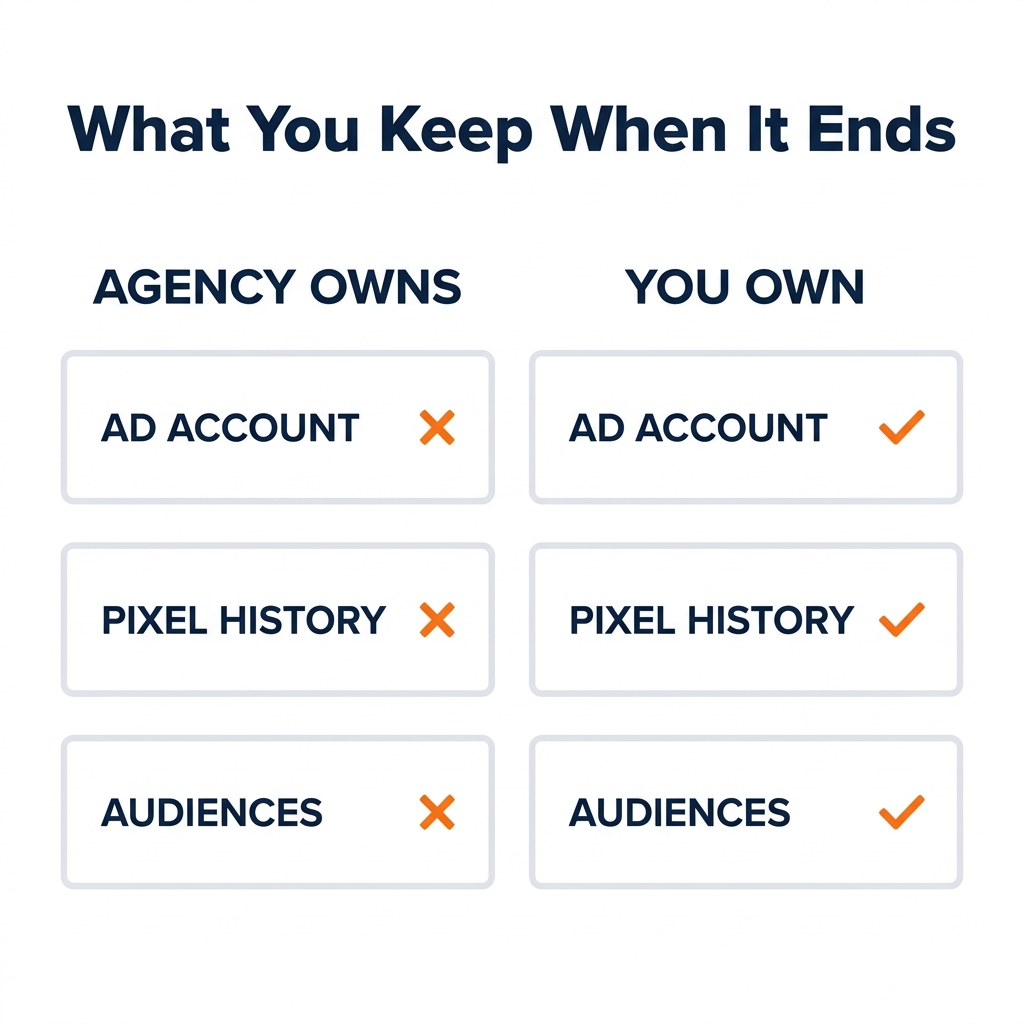
Three things, and only one of them is obvious.
The Pixel and the Conversion History
Lost pixel history is not recoverable. A new team cannot retarget the same audiences or build on your prior conversion data.
Every dollar you spent taught the platform something about who responds. That learning lives in the account. It does not follow you.
The Audiences
Some audience types can be shared between Business Managers. Others cannot be exported at all.
For anyone running continuous retargeting, a cutover creates a gap that can last the full length of your lookback window. You are not slowed down for a week. You are dark for as long as the window runs.
Your Account Reputation
This one is invisible until it costs you. If your ads run inside an agency's account, your ad reputation is pooled with the behavior of every other brand in that account.
You inherit their compliance history. In a regulated category, that is not a small thing to hand over quietly.
The Structure That Actually Solves It
Partner access, pointed the other direction.
You run ads inside your own Business Manager, with your own pixel, on your own hosting. The agency gets access, not ownership.
Set up that way, you keep the ad account, the pixel data and the audiences. You can revoke the agency's access at any time. Your historical data stays where it already is, because it never moved.
Notice what this does to the switching conversation. It stops being a negotiation and becomes an administrative task.
The 24/7 Rollover Pipeline is built this way on purpose. We build the ads, the funnel, the asset qualification and the CRM inside your own accounts, then run all of it. Your ad account, your card, your pixel, your audiences. If we ever stop working together, you keep a working system instead of an invoice history.
What to Put in the Contract
Ask for these in writing before you sign. Commonly recommended terms include:
- Campaign data, audience data, conversion history and analytics access belong to you
- All creative assets, including video files, images and copy, are delivered to you at contract end
- The ad account and pixel sit in your Business Manager, with agency access granted rather than owned
- A defined written notice period for termination
- A defined transfer window for assets after notice is given
None of that is exotic. An agency that will not put it in writing is telling you something.
The One Question That Replaces All of Them
If you only ask one thing on the call, ask this.
What do I keep if we stop working together next quarter?
The answer takes about four seconds and tells you more than the rest of the pitch.
Where This Sits in Your Appointment Economics
Ownership is not a philosophical preference. It is a line item.
When you keep the account, the learning compounds and your cost per appointment tends to improve over time. When you start over with a new vendor every eighteen months, you pay the learning curve again every time, and then you conclude that paid advertising does not work in this market.
It works. You just never got to keep any of it.
That is why we treat this as an economics question, not a trust question. For the full breakdown of what each acquisition channel actually costs, see our guide to annuity appointment setting for advisors.
Ask Who Owns the Ad Account Before You Sign
You do not need to fire anyone today. You need one email to your current agency asking which Business Manager holds the ad account and the pixel.
If the answer is theirs, you now know what you are actually buying each month.
This article is written for licensed insurance and financial professionals. It is not a solicitation to consumers and it is not financial advice.
Curious what it looks like to own the machine instead of renting it?
We build the ads, the funnel, the qualification and the CRM inside your accounts, then run it. Your ad account, your card, your pixel, your audiences. If we ever stop working together, you keep a working system.
One advisor per territory.
Frequently Asked Questions
Who owns the ad account, the agency or the client?
It depends entirely on how it was set up. Meta's published best practices tell agencies to hold the ad account in their own Business Manager and give the client partner access, while the client holds the pixel and Page. Many practitioners recommend the reverse, with the advisor holding the ad account and granting the agency access. Whoever's Business Manager pays the platform generally holds the account, so check that first.
What happens to pixel data when you switch marketing agencies?
If the pixel sat in the agency's Business Manager, the conversion history is not recoverable. Your new team cannot retarget the prior audiences or build on that data. Some audience types can be shared between Business Managers and others cannot be exported at all, so for continuous retargeting a cutover can leave a gap lasting the full lookback window.
Can an agency refuse to hand over your ad account?
Yes, if the account sits in their Business Manager and your contract does not require transfer. This is a documented risk when the relationship ends, and it is the main reason practitioners recommend advisors hold ad account ownership themselves and grant access instead.
What should a marketing agency contract include for advisors?
At minimum it should state that campaign data, audience data, conversion history and analytics access belong to you, that creative assets are delivered at contract end, that the ad account and pixel live in your Business Manager, and that there is a defined notice period and asset transfer window on termination.