
Annuity Lead Qualification Questions That Actually Work
Most annuity lead qualification questions filter for the wrong thing. They ask age and zip code, then call the result qualified.
Age and zip code is demographics. Here is what actually separates a prospect worth an hour from one who is not.
A note on scope: this article is about marketing qualification, meaning which prospects should reach your calendar. It is not about suitability, product selection, or what to recommend once you are in the meeting. Those are different jobs with different rules.

Why Most Annuity Lead Qualification Questions Fail
Most advice on how to qualify annuity prospects lists the same criteria: age, life stage, assets, income, tax situation and retirement plans.
That list is fine. The problem is that most lead forms only ever ask the first one. An annuity lead form that collects a name, a phone number and an age has not qualified anybody.
Age is easy to collect and easy to verify. Assets are awkward to ask about, so most forms skip it or bury it in a vague range. Then the advisor finds out at the appointment.
That is the same structural mistake seminars make, just in digital form. The filter runs after the spend, not before it.
The Cost of Getting It Wrong
Published pricing puts exclusive annuity web leads at roughly $75 to $150 each, typically filtered to age 55 and up.
At that price, a lead with no movable money is not a small loss. It is the lead cost plus the call, plus the follow-up sequence, plus the hour you gave it.
What "Investable Assets" Actually Means
If you are going to ask one asset question, this is the term to use, and it has a real definition.
Investable assets are the portion of someone's wealth that is liquid, transferable, and available to be invested. That is the whole test.
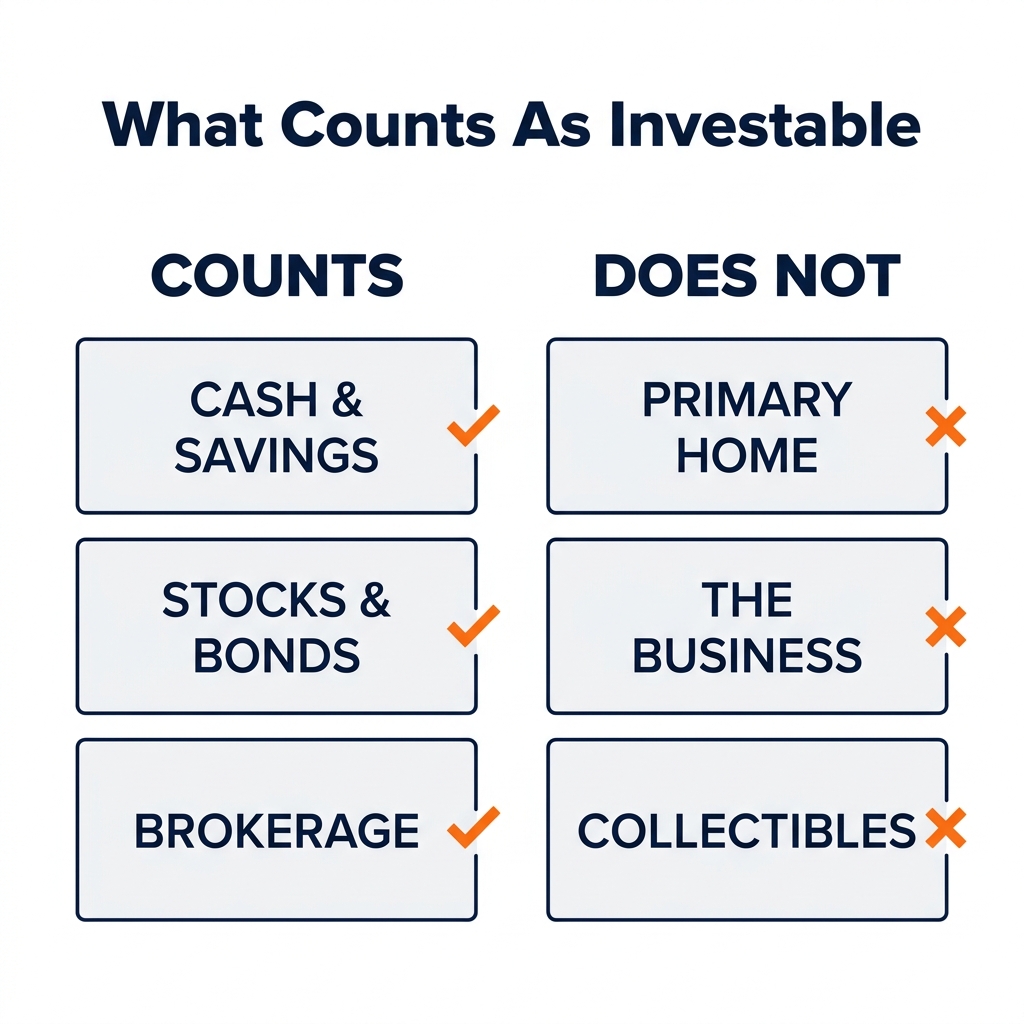
What Counts
Cash. Cash-equivalent holdings in savings accounts and short-term deposits. Dividends. Publicly traded marketable securities, meaning stocks, bonds and ETFs. Certain short-term alternatives.
The common thread is that all of it can be moved without selling something that changes the person's life.
What Does Not Count
Directly held private business interests. Real estate of every kind, including the primary residence and any investment property. Luxury personal goods and collectibles. Any other non-tradeable, illiquid asset.
This is where most self-reported numbers inflate. A prospect who says "about a million" is often counting a paid-off house and a business valuation. Neither can fund anything.
Why the House Is Excluded
Four reasons, and they are worth being able to explain on a call.
It is illiquid, and selling is neither simple nor fast. Transaction costs are substantial once you count realtor fees and closing costs. It carries emotional attachment that works against clear decisions. And the person has to live somewhere, which makes it a lifestyle asset rather than an investment.
Even when a home appreciates well, that gain does not become deployable capital without a major life disruption.
The Four Annuity Lead Qualification Questions That Filter Properly
Four questions. Each one removes a different kind of bad appointment.
Question 1: How Much Can Actually Move?
Ask for a range, not an exact figure. People will give you a range honestly and will refuse an exact number.
State the exclusions inside the question itself. "Not counting your home or a business, roughly how much is in retirement or investment accounts?" That single clause does most of the filtering work.
Question 2: Where Does It Sit Right Now?
401k, IRA, brokerage, CDs, savings, or an existing annuity. You are not asking so you can recommend anything. You are asking whether the money is somewhere that can move at all.
Money funded with pre-tax dollars behaves differently from money funded with after-tax dollars. For qualification purposes you only need to know which bucket it is in, not what to do about it.
Question 3: When Does It Become Available?
This is the question almost no lead form asks, and it is the one that saves the most wasted hours.
Surrender periods commonly run five to ten years, and moving money before the period ends can cost 7 percent or more of the account value.
A prospect two years out from the end of a surrender period is not an appointment. They are a callback with a date on it. Booking them as an appointment makes your delivery numbers look better than your calendar feels.
Question 4: Are They Actually Looking?
Intent is not the same as eligibility. Someone can have the assets and no interest in moving them this year.
Ask what prompted them to fill out the form. The answer separates a person with a reason from a person who clicked.
The 24/7 Rollover Pipeline runs these questions before anything reaches your calendar. We build the ads, the funnel, the asset qualification and the CRM inside your own accounts, then run all of it. Prospects self-report investable assets in the form and confirm them again with a person on the phone. Your ad account, your card, your pixel, your audiences.
"Qualified Annuity Leads" Is a Meaningless Phrase Without a Number
Here is a line worth remembering when a vendor pitches you.
A qualified lead to one producer may mean $50,000 of investable funds. To another producer it means $250,000. The published guidance is explicit that terms like "qualified annuity leads" and "high-quality annuity leads" are subjective to whoever is using them.
So the phrase carries no information on its own. Ask for the threshold.
Published reporting puts the typical annuity prospect at $250,000 to $750,000 in net worth excluding a luxury home. If a vendor is selling leads without naming a floor, they are almost certainly delivering the bottom of that range.
Our own gate is $250,000 to $1,000,000 in investable retirement assets. That number is stated on purpose, because a threshold you cannot name is not a threshold.
Self-Reported Is Fine. Just Say So.
Every asset figure on a lead form is self-reported. Nobody uploads a statement to a landing page.
That is not a weakness as long as you describe it accurately. A prospect states the range in the form, and a person confirms it on the phone before anything gets booked. Confirmed twice.
What you should not do is call it verified. No vendor is auditing a stranger's balance sheet over the phone, and any vendor claiming otherwise is telling you something about how they handle the rest of it.
Where Annuity Lead Qualification Questions Belong in the Funnel
Not at the appointment. Not at the dinner table. Before the spend.
That sequence is the entire difference between a channel that scales and one that just gets more expensive, which we break down channel by channel in our guide to annuity appointment setting for advisors. It is also the specific reason annuity seminars have gotten harder, since the room is paid for long before anyone answers question one.
Put these four questions in front of the money and the same budget produces a different calendar.
This article is written for licensed insurance and financial professionals. It is not a solicitation to consumers and it is not financial, tax, or suitability advice.
Want the qualification running before you pay for the appointment?
That is the whole mechanism. Prospects answer the asset questions in the funnel, a person confirms the range on the phone, and only then does anything reach your calendar.
One advisor per territory.
Frequently Asked Questions
What questions should be on an annuity lead form?
The four annuity lead qualification questions that matter are how much money can actually move, where it currently sits, when it becomes available, and what prompted the person to enquire. Age and zip code alone are demographics, not qualification. State the exclusions inside the asset question so the prospect does not count a house or a business.
What counts as investable assets?
Investable assets are holdings that are liquid, transferable and available to invest. That includes cash, cash equivalents in savings and short-term deposits, and publicly traded securities such as stocks, bonds and ETFs. It excludes private business holdings, all real estate including the primary residence, luxury goods, collectibles and other illiquid assets.
Why is a primary residence excluded from investable assets?
It is illiquid and slow to sell, transaction costs are substantial, it carries emotional attachment that works against clear decisions, and the person needs somewhere to live. That makes it a lifestyle asset rather than an investment. Appreciation on a home does not become deployable capital without a major life disruption.
How do you know if an annuity prospect's money can actually move?
Ask when it becomes available. Surrender periods commonly run five to ten years, and moving money before the period ends can cost 7 percent or more of the account value. A prospect partway through a surrender period is a callback with a date attached, not an appointment, and treating them as one distorts your pipeline numbers.