
SMS Verified Medicare Leads: What Agents Need to Know
Most Medicare leads come from a simple form submission. The prospect fills in their name, phone number, and email — and the lead fires to your CRM. No confirmation. No proof the number is real. SMS verified Medicare leads work differently, and the difference shows up in every downstream number in your pipeline.
What SMS Verified Medicare Leads Actually Are
The Verification Step Most Lead Vendors Skip
SMS verification adds one step between form fill and lead delivery.
After the prospect submits their contact information, the system sends a one-time passcode to the mobile number they entered. They must type that code back into the form to complete the submission.
If they entered the wrong number — by accident or intentionally — the code never reaches them. They cannot complete the form. The lead never generates.
What reaches your CRM is a confirmed, working mobile number attached to a real person who took a deliberate extra step to request information.
What Gets Filtered Out Before Delivery
Standard form submissions routinely include typos — transposed digits that nobody will ever answer. They include intentionally fake numbers, from people who want the free resource but not the follow-up call. They include bot traffic from automated form scrapers. They include low-intent browsers who clicked out of curiosity and moved on.
Your setter calls none of these people. But with standard leads, you pay for every one of them — and waste time chasing numbers that go nowhere.
SMS verification removes all of these before the lead reaches you.
Why SMS Verified Medicare Leads Change Your Contact Rate
The Intent Signal Behind the Code
The one-time passcode does more than confirm a phone number. It creates an intent signal.
Checking a text, reading a 6-digit code, and typing it back into a form takes about 30 seconds. That is enough friction to separate someone genuinely interested from someone who was just clicking. A prospect who completes SMS verification is telling you something: they wanted the follow-up enough to act on it twice.
That is a fundamentally different quality of contact than someone who filled out a form in 10 seconds while scrolling.
Speed to Lead Still Applies
SMS verification raises the quality floor on every lead. It does not remove the need for fast follow-up.
A verified lead still goes cold if your setter waits two hours to make contact. The verification confirms intent at the moment of opt-in. Speed to lead is what captures that intent before it fades.
The benchmark is first contact within five minutes of opt-in. SMS-verified leads give your setter better raw material to work with. Speed to lead is what converts that material into booked appointments.
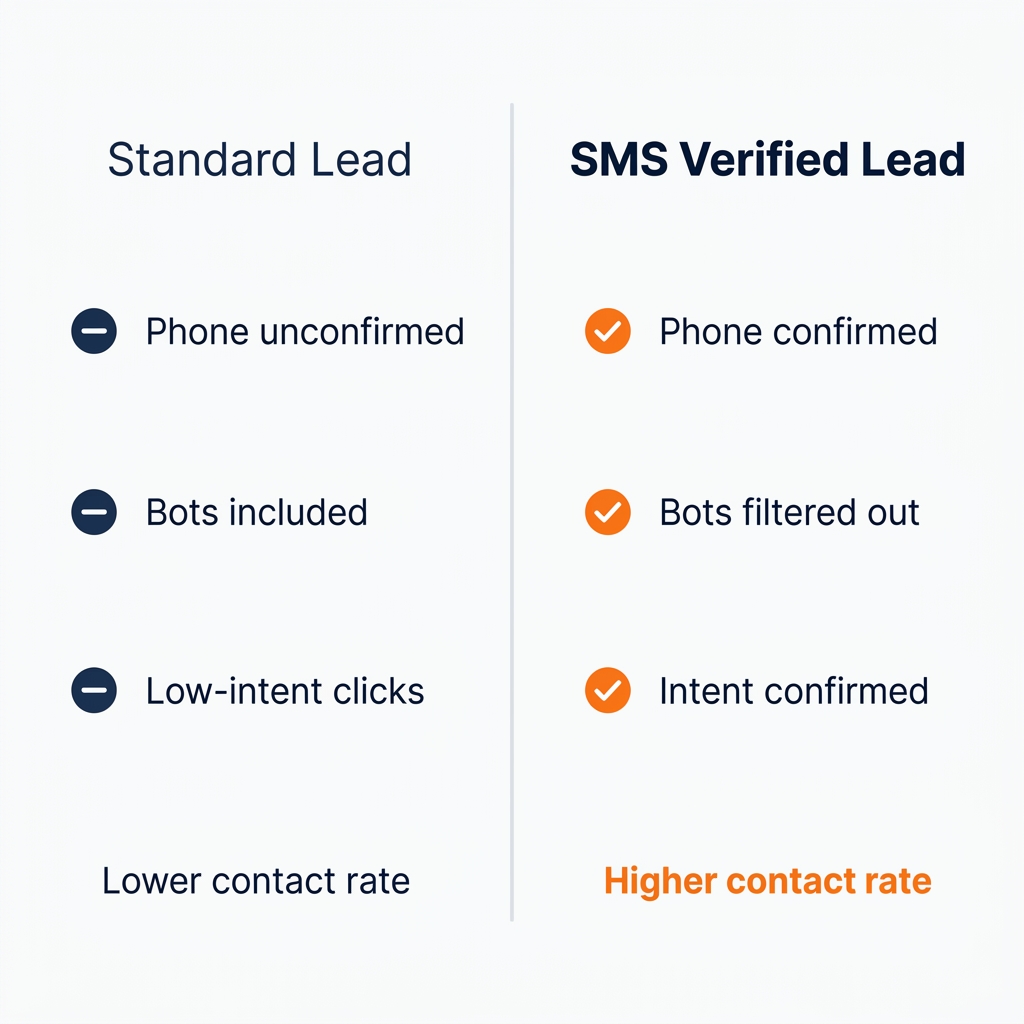
SMS Verified Medicare Leads vs. Standard Medicare Leads
Standard leads: Form fill only. No phone confirmation. Every submitted number reaches your CRM — including wrong numbers, fake entries, and low-intent clicks. Your setter works volume, hoping to reach someone real.
SMS-verified leads: Phone number confirmed before delivery. Every lead that reaches your CRM has a working mobile number attached to a person who confirmed their interest twice. Your setter works a smaller list with a significantly higher contact rate.
The tradeoff is volume. SMS-verified leads come in lower volume than standard leads from the same campaign. But fewer leads with a high contact rate produces more actual conversations than a larger list full of dead numbers.
Shared leads compound the problem. Not only are most shared leads unverified — the same lead goes to 3 to 5 other agents simultaneously. Your setter is racing three competitors to a number that may not even be real.
For the full data on how shared leads affect contact rate downstream, that breakdown is here.
What Verified Lead Quality Does to Your Pipeline Math
At a 22% book rate — the benchmark for agents with a proper follow-up system — 25 exclusive leads per month produces 5 to 6 booked appointments. At 75% show rate, that is about 4 shows. At 30% close rate, that is approximately 1.2 new clients per month.
SMS verification protects that 22% book rate. When the lead pool contains no wrong numbers, no bots, and no low-intent form fills, your setter spends less time on dead ends and more time on real conversations.
Without verification, book rate on standard or shared leads typically runs 10 to 15%. The leads look identical on paper. Contact rate is what separates them.
Every downstream number — appointments booked, shows, enrolled clients, first-year commissions — flows from that first contact. SMS verification is where the pipeline either holds or leaks.
For the follow-up sequence that works alongside SMS-verified leads, the Medicare lead follow-up system post covers the full setup.
SMS Verified Medicare Leads Are the Starting Point
Verification is not a premium feature. It is the baseline that makes the rest of your system worth running.
If you want to know where your current pipeline is leaking — lead quality, follow-up speed, show rate, or something else — the Roadmap will show you.
Take the free 60-second assessment and get your personalized Medicare Lead Gen Roadmap. It benchmarks your current setup and shows you what to fix first. Free, no pitch.
Get Your Free Medicare Lead Gen Roadmap
Or if you are ready to talk now, book a free 20-minute strategy call. No pitch. Just a look at your market and what consistent verified leads could look like for you.
Frequently Asked Questions
Q: What does SMS verified mean for Medicare leads?
A: SMS verified Medicare leads require the prospect to confirm their phone number via a one-time passcode before the lead is delivered. The system sends a code to the number they entered — they must type it back to complete the form. This eliminates wrong numbers, bots, and low-intent submissions before the lead ever reaches your CRM.
Q: Do SMS verified Medicare leads have a higher contact rate?
A: Yes. SMS-verified leads eliminate the wrong numbers and fake submissions that drive contact rate down on standard lead lists. Because every lead that reaches your CRM has a confirmed, working mobile number, your setter spends time on real conversations instead of chasing dead ends.
Q: Why does SMS verification matter for show rate?
A: The verification step creates an intent signal. A prospect who completes SMS verification has confirmed their interest twice — once with the form fill and once with the code. That additional commitment correlates with higher show rates because the prospect is more engaged from the start, not just a casual click.
Q: Are SMS verified Medicare leads lower volume?
A: Yes, and that is by design. SMS verification filters out low-intent and invalid submissions, so the total lead count is lower than standard leads from the same campaign. But fewer high-quality leads with strong contact rates produces more conversations and more booked appointments than a larger list of unverified contacts.