
Real-Time Medicare Leads: Why the 5-Minute Rule Wins
Real-time Medicare leads are the highest-quality leads available to independent agents. But they only work if your follow-up is fast.
Most agents lose those leads in the first 30 minutes. Not because the lead was bad. Because someone else called first.

What Real-Time Medicare Leads Actually Are
A real-time Medicare lead is generated the moment a prospect fills out an opt-in form online. That lead goes straight to your CRM in seconds, not days.
Compare that to an aged lead. An aged lead comes from the same type of form. But the prospect filled it out 30 to 365 days ago. They may have already enrolled with another agent. They may not even remember filling it out.
The core difference is intent. A real-time lead represents someone actively researching Medicare right now. That window does not stay open long.
Real-Time vs. Aged: A Simple Comparison
Real-time Medicare leads cost more per lead, typically $20 to $50 each. Aged leads can cost as little as $0.25 to $5.00 per lead.
That cost difference looks dramatic. But the number that matters is not cost per lead. It is cost per booked appointment. On that metric, real-time leads compete very differently.
The 5-Minute Rule for Real-Time Medicare Lead Follow-Up
Here is what the research shows. Contacting a lead within 5 minutes of form submission increases your contact rate exponentially compared to waiting 30 minutes or more.
That is not a marginal improvement. It is the difference between a system that works and one that does not.
For real-time Medicare leads, this matters even more. The prospect just raised their hand. They are at peak intent. They expect to hear from someone fast. If you wait an hour, that window has closed. Another agent has likely filled it.
What Happens to Contact Rates Over Time
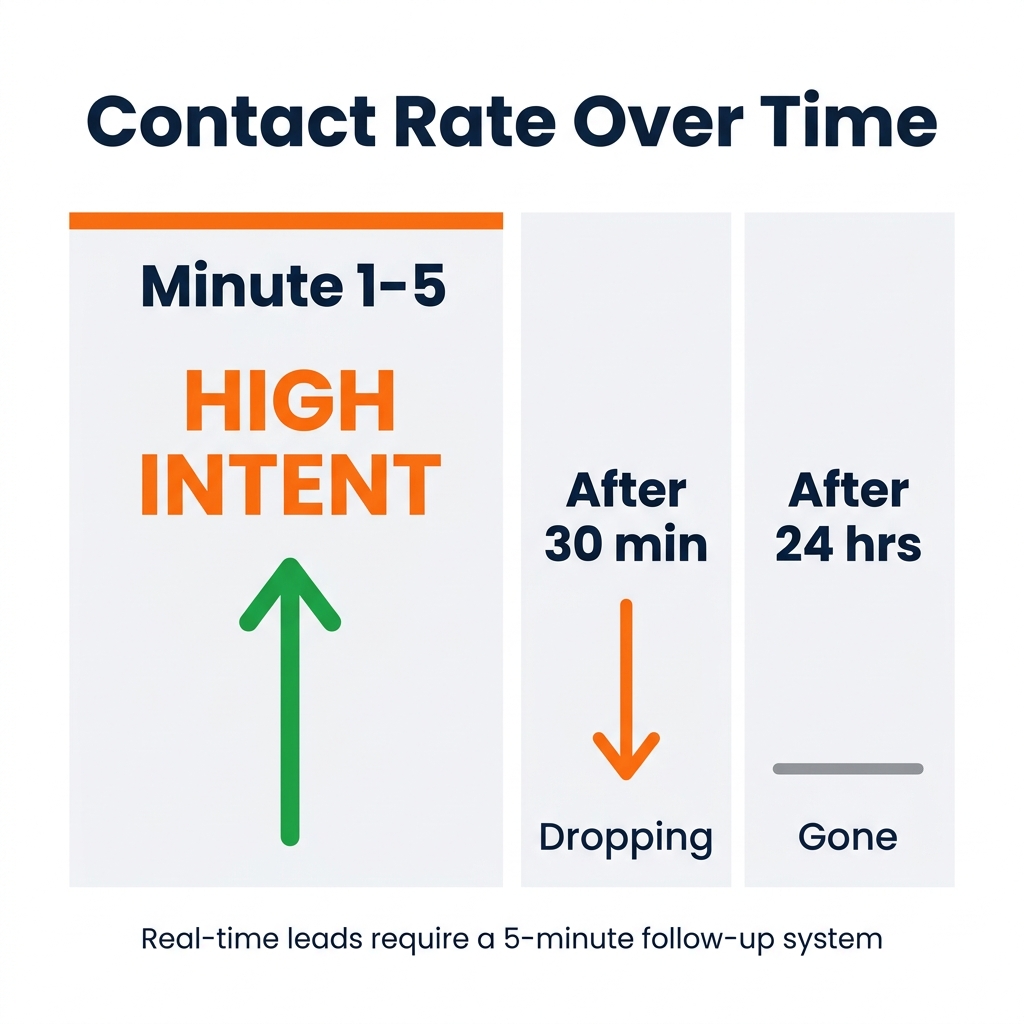
The drop-off after the first 5 minutes is steep. After 30 minutes, contact rates fall significantly. After 24 hours, many prospects have moved on or picked up the phone with someone else. After a week, the lead has functionally aged.
This is why lead type and response system have to work together. A real-time lead delivered to an agent with no follow-up automation is not better than an aged lead. It just costs more.
The GHL Connection
A proper GHL setup triggers an automated SMS within 60 seconds of a form submission. That text arrives while the prospect is still on their phone. Your setter follows up with a call immediately after.
That combination, automated SMS plus immediate call, is what converts real-time Medicare leads at a higher rate. The system handles the speed. The setter closes the appointment.
If you want to see how this workflow is structured, the Medicare lead follow-up system breakdown covers the step-by-step setup.
Real-Time Medicare Leads: The Cost Per Appointment Math
At a $50 cost per lead and a 22% book rate, one booked appointment costs about $227. At a 75% show rate, one showed appointment costs about $303. At a 30% close rate, one enrolled client costs about $1,010.
Now compare that to aged leads. The per-lead cost is lower. But contact rates on aged leads are much lower too. If you are reaching 1 in 10 aged leads, your effective cost per contact is already close to a real-time lead. And your conversion rate from that contact is lower because the intent is lower.
The math does not always favor real-time. But for agents with a fast follow-up system and a setter process in place, real-time Medicare leads often produce a lower cost per enrolled client.
What Makes a Real-Time Medicare Lead High Quality
Not all real-time leads are equal. Here is what separates a high-quality real-time lead from a low-quality one.
It Is Hand-Raised
The prospect actively filled out a form. They were not auto-enrolled in a call list or pulled from a broker database. They chose to request information. That intent signal is the foundation of a good lead.
It Is SMS-Verified
A verified lead means the prospect confirmed their phone number via text before the lead was delivered. That one step filters out wrong numbers and low-intent fills. Your contact rate goes up before the lead ever reaches your CRM.
You can read more about how verification affects show rates in the SMS-verified Medicare leads breakdown.
It Is Exclusive
An exclusive lead goes to one agent. Not five. Not ten. You are the only person calling. That means you are not racing another agent to the same phone number. That is the shared lead problem most agents are trying to escape.
For a full look at how contact rates compare between exclusive and shared leads, the exclusive Medicare leads contact rate data breaks it down.
It Is T-65 Timed
The best real-time Medicare leads target people approaching their 65th birthday inside the Initial Enrollment Period (IEP). Around 10,000 people turn 65 every day in the United States. The IEP window opens 3 months before their birthday and closes 3 months after. That is a defined, predictable moment of high buying intent.
Why Most Agents Lose Real-Time Medicare Leads
The problem is not finding real-time leads. The problem is following up fast enough to use them.
Most agents do not have an automated response system. They are manually checking inboxes, dialing by hand, or routing leads through spreadsheets. By the time they get to a real-time lead, it is not real-time anymore.
The agents who convert real-time Medicare leads consistently have three things in place. First, a CRM that triggers an automated SMS the moment a lead comes in. Second, a setter who calls within minutes of that text. Third, a confirmation system that reduces no-shows before the appointment.
Without all three, a real-time lead is just an expensive aged lead.
If you want to understand the full system behind consistent Medicare lead generation, the Medicare lead generation for agents guide covers the end-to-end structure.
Build a System That Can Win in 5 Minutes
Real-time Medicare leads are only worth the investment if your system is fast enough to use them. The lead quality sets the ceiling. Your follow-up speed determines whether you reach it.
If your current pipeline relies on manual dialing and delayed follow-up, the lead type is not your problem. The system is.
Are you getting real-time Medicare leads but losing them before the first call?
Take the free 60-second assessment and get your personalized Medicare Lead Gen Roadmap. It shows you exactly where your follow-up is breaking down and what to fix first.
Get Your Free Medicare Lead Gen Roadmap
Or if you are ready to talk now, book a free 20-minute strategy call. No pitch. Just a look at your market and what consistent appointments could look like.
Frequently Asked Questions
Q: What is the difference between real-time Medicare leads and aged leads?
A: Real-time Medicare leads are delivered to an agent within seconds or minutes of the prospect filling out a form. Aged leads come from the same type of form submission but are 30 to 365 days old. The key difference is intent. Real-time leads represent peak interest, while aged leads require more follow-up effort to reach and convert.
Q: How quickly should I follow up on a real-time Medicare lead?
A: Within 5 minutes of form submission, and ideally within 60 to 90 seconds. Research shows that contacting a lead within the first 5 minutes dramatically increases contact rate compared to waiting 30 minutes or more. A GHL automation that triggers an immediate SMS is the most reliable way to hit this window consistently.
Q: Are aged Medicare leads worth buying?
A: Aged leads can work for agents with a high-volume dialing system and the capacity to work a large list. But the contact rate is lower and the intent is lower. For agents focused on appointment efficiency, real-time exclusive leads typically produce a lower cost per enrolled client despite the higher per-lead cost.
Q: What makes a real-time Medicare lead high quality?
A: The four factors are hand-raised intent (the prospect chose to fill out the form), SMS verification (they confirmed their phone number), exclusivity (no other agent is calling the same lead), and T-65 timing (the prospect is actively in the IEP window). All four together produce a lead with a high contact rate and strong conversion potential.